
What capabilities do you need for the trading organisation of tomorrow?
7 min read 7 May 2026
In commodity trading, change and transformation programmes too often fail to deliver on their promise. This is frequently driven by a lack of clarity and alignment among business and project teams.
Our experience shows that establishing a capability model as a foundational project document significantly improves delivery outcomes, by aligning business and project teams around a shared, coherent vision of the future.
What is a capability model?
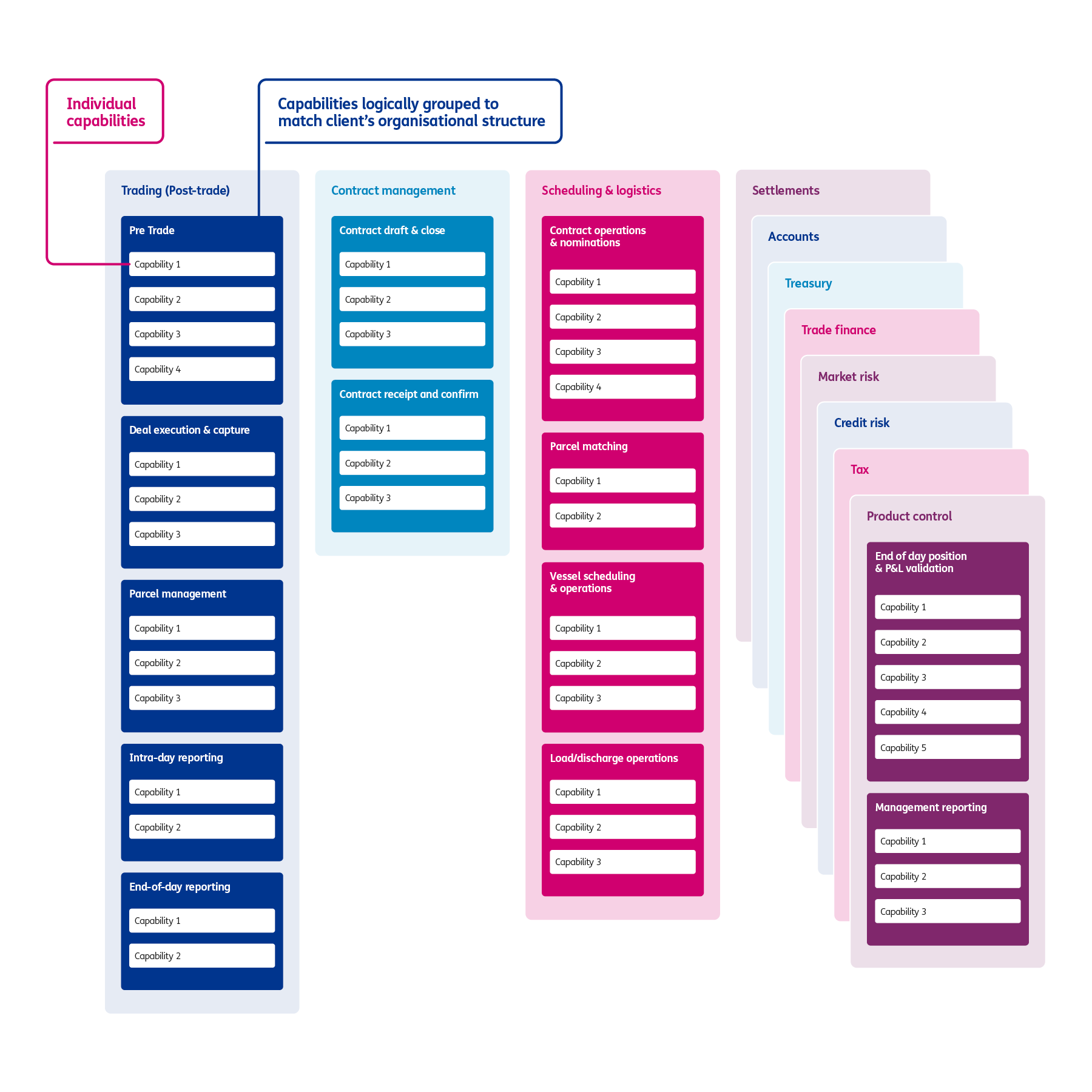
A capability model is a structured representation of everything a trading business must be able to do, from the moment a trade is agreed through to its settlement and accounting, organised to reflect how that specific business is structured.
Well‑designed capability models share several defining characteristics. They are:
- Rooted in capability, not process, describing what must be done rather than how it is done
- Designed to be easy to read and intuitive to understand
- Designed to enable the overlay of additional information, such as systems, processes, trade types, gaps, or capability maturity, linking to other key pillars of how the business operates
Capability models are powerful because they provide a stable, structural backbone for understanding the business, while remaining adaptable enough to support analysis, discussion, and design.
Why capability models are the foundation for organised transformation
Transformations are far more likely to succeed when business and project teams share a clear, common vision of how the business operates today, and how it needs to operate after the transformation.
Defining this vision is not straightforward for commodity trading organisations.
While trading businesses share many of the same underlying capabilities, the way those capabilities are organised — and who is responsible for them — can vary significantly from one business to the next.
A capability model makes these differences explicit, showing clearly how responsibilities are distributed across the business, and where different teams begin and end their accountability. This gives both business and project teams a shared, agreed view of how the organisation works, establishing the trust and common understanding that is essential before any major transformation can begin.
Once built, the model becomes a reference point for deeper conversations about how the business works, covering processes, systems, data, and reporting. Because these conversations are anchored in a framework that everyone has already agreed on, they happen faster and with far less friction.
Source: Baringa
How to use capability models to drive a transformation programme
Successful large-scale transformation requires clarity and alignment on both how the business works today and how it needs to work tomorrow.
In practice, this means working with two closely linked capability models:
- A current‑state, how the business is structured today
- A future-state (or ‘North Star’), what will change as a result of the transformation
Using the current‑state capability model
During the diagnostic and discovery phases, the current-state capability model provides a neutral, business-led way to describe how the organisation works.
Rather than starting with systems or processes, which can pull discussions toward technology too early, the model anchors the programme in a shared, practical view of how the business actually operates.
This involves answering fundamental questions such as:
- What teams exist?
- What are they responsible for?
- Where do responsibilities begin and end?
Once agreed, the current-state view becomes a stable platform for deeper analysis and builds early trust between the business and the programme team.
It can be used to explore:
- Which systems support which capabilities
- Where processes cut across organisational boundaries
- Where gaps or duplications exist
- How mature different parts of the business are relative to peers or best practice
Critically, because this analysis is anchored in a view the business itself recognises, it enables the programme to surface real issues quickly, and keeps business and project teams moving forward together.
Designing the future‑state capability model
Once aligned on the current state, the transformation moves from understanding to design.
The future-state capability model uses the same structure, but with a different intent: defining how the business should be organised going forward.
It makes explicit:
- Where responsibilities will change
- Which capabilities will be consolidated, separated, or given greater prominence
- The relative scale and impact of change across teams
Its real power lies in the comparison between current and future states, making the nature, scale, and implications of change visible, tangible, and actionable.
It then plays a critical role in delivery by:
- Providing a clear contract between the business and delivery teams
- Providing a clear organisational framework for the transformation programme
- Giving teams a consistent structure against which requirements and design decisions can be made
Accelerating transformation with structure and best practices
When transformation is anchored in capability models, organisations gain a stable reference point for all change activity. They are more than diagrams, they are the foundation of organised transformation, enabling:
- A confident, shared understanding of the current state
- Clear alignment on the future-state vision
- Coherent delivery of complex change
Baringa has developed a comprehensive baseline of capabilities covering physical and derivatives commodity trading across major commodity classes, including power, gas, oil and liquids, LNG, metals, agriculture, shipping, and trade finance. We then tailor this to reflect each client's specific business, ensuring the model is grounded in their reality from the outset.
Combined with our deep industry expertise, this approach allows us to build robust, tailored capability models quickly, establishing the shared language and trust between business and project teams that is foundational to every successful transformation.
Contact us to learn more.
Our Experts

Related Insights

Unlock the key to successful trading transformation
Discover how Baringa helps energy and commodity businesses deliver faster, lower-cost change with lasting impact.
Read more
Navigating the ETRM and CTRM landscape: trends shaping smarter technology decisions
In this article, we demystify the complexity and look at trends that will help you make more informed decisions.
Read more
How to solve the data paradox in commodity trading
Implement successful change programmes that modernise operations, enhance performance and position your commodity trading business for long‑term growth.
Read more
Adapting to the renewables era: How energy trading organisations can capture maximum value
This article highlights the key steps to success in energy trading’s future, offering a clear path for organisations ready to adapt and lead.
Read moreIs digital and AI delivering what your business needs?
Digital and AI can solve your toughest challenges and elevate your business performance. But success isn’t always straightforward. Where can you unlock opportunity? And what does it take to set the foundation for lasting success?
 Stay informed
 Energy and resources newsletter