
The personalisation imperative: how health insurers are boosting loyalty
5 min read 9 April 2026
The health insurance market is at an inflection point. Rising customer expectations, accelerating digital adoption, and shifting generational behaviours, alongside increasing demographic and cost pressures on the NHS that are driving greater reliance on private provision, are collectively reshaping what it means to deliver a compelling insurance proposition - and insurers that fail to adapt risk being left behind.
Baringa's 2025 Insurance Survey, examined loyalty drivers, digital experience expectations, and the evolving challenges insurers face in meeting growing customer demand. The survey - which interviewed 4,000 insurance customers and 400 senior insurance executives across the UK and US - highlighted personalisation as the top driver of loyalty.
We have drilled down into our UK Health insurance respondents aged between 16-34 to determine what this means for the UK Health Insurance market. As digital experiences become the primary lens through which health insurance is bought, managed, and valued, meeting the expectations of younger demographics is no longer optional, it is a strategic imperative.
Our data reveals a clear generational shift; younger customers increasingly expect personalised digital interactions, paired with rewards, incentives, and benefits that feel genuinely relevant to their lives. For health insurers, getting this right will be critical to building lasting loyalty and standing out in an increasingly competitive market.
Rehumanising health: Why personal care has been lost
In the latter part of the 20th century, healthcare remained a largely personal experience. Care was typically delivered through local GP practices that knew their patients, medical histories, and often their families. Relationships were built over time, grounded in trust and continuity, and with a clear sense that the person providing care was invested in the patient’s long-term health. However, the patient experience has fundamentally changed due to growing demand and sustained pressure on the NHS, alongside the rise of private health insurance. While these shifts have helped address access and capacity challenges, they have also diluted the sense of personalisation that once defined healthcare. Experiences have become more standardised, journeys more fragmented, and interactions increasingly transactional.
At the same time, across banking, retail, and entertainment, younger customers are used to highly personalised digital experiences. They now expect the same level of personalisation from their health insurers. And although health remains a highly personalised and non-commoditised form of insurance, these rising expectations mean there’s a disconnect between expectation and reality - and customer loyalty is increasingly fragile as a result.
Digital personalisation is a key differentiator
Our latest survey data illustrates how digital personalisation is emerging as the primary solution for addressing this disconnect and enabling insurers to better reflect individual needs while operating at scale.
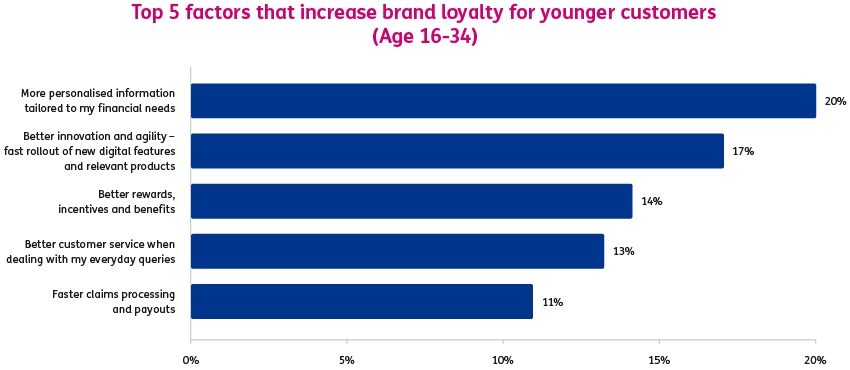
Personalised information tailored to a customer’s financial needs ranked as the single biggest factor influencing provider loyalty amongst the under 34 customer segment, ahead of agility and the rollout of new digital features.
Customer expectations reflect this. Customer touchpoints throughout the health journey - such as understanding coverage, navigating benefits, or resolving claims payment issues - which fail to reflect members’ specific circumstances, can feel outdated or disconnected from how they actively manage their health on a day-to-day basis. Conversely, when members receive relevant communication and personalised journeys supported by smoother, more integrated care experiences, friction is removed and their trust grows.
As a result, personalisation directly influences:
- How customers perceive value
- How likely they are to engage digitally
- How they feel navigating their coverage
Customers switch in search of better digital capabilities
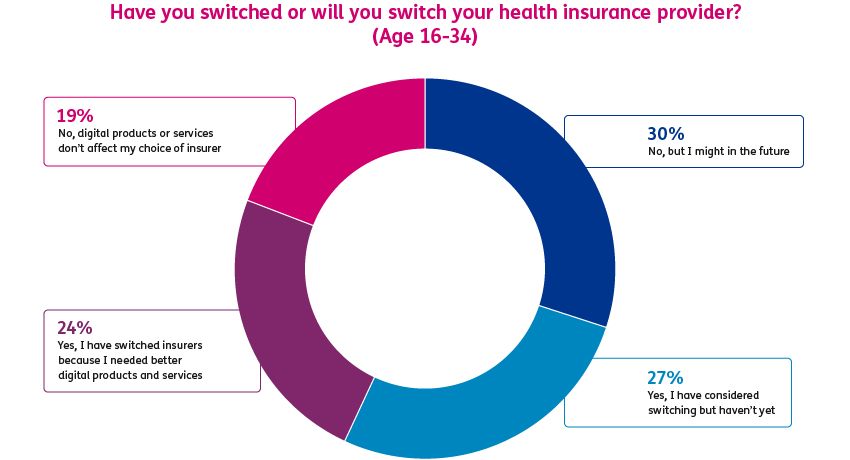
More than half of respondents aged 16-34 have either switched or actively considered switching their provider due to digital capabilities: 24% have already switched in search of better digital products and services, and a further 27% have considered switching for this reason. Another 30% said they may switch in the future.
Only 19% of respondents in this data subset said that digital products and services have no influence on their choice of insurer.
Together, this insight points to clear demand for more tailored and digitally seamless journeys. In a competitive market where switching providers is easy, insurers that deliver intuitive, relevant digital experiences reduce fragmentation across the end‑to‑end journey, build trust and loyalty. Those that don’t risk losing members to competitors.
Personalisation should go beyond surface-level tailoring
Despite the clear customer demand, delivering meaningful personalisation in health insurance remains challenging. Health journeys are inherently more complex than those in other industries. Unlike entertainment or banking, interactions in private health are often sporadic, emotionally charged, and highly variable. Insurers must also balance the need for efficiency and scale with expectations around individual care.
As a result, personalisation initiatives often remain limited in scope, focused on basic segmentation or isolated digital interactions rather than delivering deeper end to end relevance. More effective approaches consider the full context of the member, tailoring journeys, guidance, regards, and next basic actions across the entire health experience.
Make customer experience a design principle, not an outcome
Delivering personalisation isn’t simply a technology challenge, but many insurers continue to approach digital transformation primarily through a cost-efficiency or platform lens.
Customer experience, alongside the establishment of trust, should be treated as design principles, not a secondary outcome. When delivered effectively using this approach personalisation;
- Goes beyond segmented messaging or tailored communications
- Helps insurers anticipate member needs, reduce friction across journeys, and provide timely support at key moments
- Enables a shift from reactive care towards preventative services
Underpinning this is the need for strong foundational digital capabilities, not because they personalise the experience in themselves, but because they remove the friction that prevents personalisation from landing. Examples include digital integration and mobile apps features. Our survey shows that 67% of customers under 34 view digital wallet integration as an essential digital feature. In a health insurance context, this can include access to membership details via Apple or Android wallets and a simplified claims process through integrated healthcare payment cards. Building on this, 70% expect to be able to view and manage their existing policies via a mobile app. Together, these features deliver value by streamlining payments, claims, data sharing, and provider workflows, creating the seamless infrastructure on which more meaningful, personalised experiences can be built.
With this foundation in place, insurers are better positioned to evolve towards broader health ecosystems, ones where personalisation is increasingly driven by genuine customer choice across rewards, benefits, and services, rather than by insurer-defined segments.
Use personalisation to power prevention
Prevention is the industry’s emerging utopia, but is only achievable when insurers truly understand individual behaviours, risks, and preferences. This understanding is used to support earlier interventions and encourage healthier choices, reducing claim frequency. Preventative care not only improves outcomes for customers but also creates long-term value for insurers by reducing avoidable costs and strengthening trust over time. In this way, personalisation becomes a mechanism for better health, not just better digital experiences. Importantly, emerging technologies are accelerating this shift – as Bupa noted in a recent LinkedIn Article on the Reality of Personalised Healthcare, “AI is a powerful tool for personalising care, from helping to surface insights to improving the accuracy of care”, enabling earlier risk identification and more proactive support.
Industry developments reflect this wider trend towards more proactive health management models, combining preventative care and everyday health services and advisory with diagnosis and secondary care insurance pathways. For example, Vitality and Google have partnered to launch a personalised AI platform integrating member data from wearables, Vitality has launched a partnership with Boots for weight loss Services, and Bupa UK has placed strong emphasis on prevention in their 2026 strategy.
Reintroducing a sense of personal care into health journeys
The future of health insurance will ultimately be defined by how effectively insurers can reintroduce a sense of personal care into modern, scalable systems. The window to get this right is now.
Younger customers are not simply a segment to be served today; they represent a long-term growth opportunity that rewards early, sustained engagement. Capturing the 16–34 demographic is fundamentally a lifetime value question. A customer won through personalised, relevant, and frictionless digital experiences in their twenties can remain loyal across their changing health needs, life stages, and product requirements. But that loyalty must be continuously earned, maintaining relevance in the digital age means evolving alongside this cohort's expectations, not meeting them once and treating engagement as complete.
Personalisation is the mechanism through which this is achieved. As expectations continue to rise, it will play an increasingly central role in enabling better experiences, building stronger trust, and supporting more preventative approaches to health.
Done well, harnessing data and designing genuinely personalised digital journeys offers something more profound than competitive differentiation; it is an opportunity to rediscover the feeling of healthcare as it once was: personal, attentive, and centred on care rather than cost efficiency. Insurers that embed this as a core design principle will be best placed to meet evolving customer needs, capture future market share, and stand apart in an increasingly competitive market.
Please get in touch with Steven Watson, Izzy Da Costa or Numaan Arshad to talk more about this topic - and watch out for the next article in this series, which dives into additional healthcare business and customer challenges.
Our Experts

Related Insights


Helping a digital bank scale for growth
How a digital bank strengthened operations, empowered teams and built the foundations for long-term growth.
Read more
The FS AI Manifesto: Building AI That Delivers Real Value
A practical manifesto for financial services leaders on creating AI that is valuable, governable, human-centered and built to scale.
Read more
Is digital and AI delivering what your business needs?
Digital and AI can solve your toughest challenges and elevate your business performance. But success isn’t always straightforward. Where can you unlock opportunity? And what does it take to set the foundation for lasting success?
 Latest FS insights
 Exclusive interviews
 Actionable strategies