
From electric vehicles to building retrofits: What was on the agenda for leaders at our Green Homes and Business Network event?
9 May 2023
To drive the UK’s path to net-zero the industry needs to work together to build simple, easy to access propositions, taking the work out of consumer hands. To deliver this, we need to establish stronger cross-ecosystem partnerships.
Baringa is leveraging our position to help build these partnerships and has launched our Green Homes and Businesses Network. This is a collaborative platform for critical cross-sector players to address the hurdles in decarbonising the UK's buildings.
As we strive for near-term targets, the greenification of our infrastructure is non-negotiable. Progress is needed urgently, and working backwards from the finish line we need to start today, since:
- The UK has the worst-insulated buildings in Europe.
- Residential homes generate 20% of the UK’s greenhouse gas emissions.
- 13 million homes in GB can improve energy efficiency to EPC C standard.
This is not just about avoiding future hardship, decarbonising our homes also offers huge benefits:
- Improving the quality of life for more than 16 million people.
- Eliminating a key underlying cause of health and social inequality.
- Reducing customer bills, improving network operation and avoiding infrastructure investments.
The energy transition for UK homes hinges on two critical factors: unlocking value through flexibility and finding innovative solutions to retrofitting challenges. We focused the network’s first meeting on tackling these obstacles, and how collaboration and partnership can act as the key to unlocking success. In this article we share some of the insights which emerged from our discussions.
Huge potential cash savings for UK homes and businesses thanks to EV charging flexibility
During the event, Baringa’s Natasha Patel and Monica Hernandez Cedillo, and Richard Molloy from Eaton presented on how flexible EV charging could benefit UK residents and businesses. The focus was on the findings of a recent joint report exploring the value of flexible EV charging, especially when combined with additional low carbon technologies. According to the study, smart, bidirectional EV charging could save UK households over £1,000 per year, medium-sized offices over £2,000 per year, and delivery depots up to £360,000 per year. This presents a significant opportunity for savings and a crucial step towards a sustainable future.
The room's discussion centred on the significant potential of unlocking powershift flexibility, deemed essential for future network operations. The question turned to how to unlock this? The commercial viewpoint was clear on the potential value, but from a customer perspective, a clearer path is needed to drive change. Opinions varied on whether this should be a stick (e.g. enforced regulation) or a carrot (inflated value). Additionally, the conversation touched on how combining flexible operation with other low-carbon technologies could add more value and make clean heat more appealing. Participants discussed how to incentivize the "greening" of homes across various areas and make the transition fair for all.
Retrofitting buildings to boost energy efficiency
Our experts Emily Farrimond and Rebecca Teasdale joined Craig McLay of Lloyds Banking Group to give a presentation discussing how partnerships can accelerate the retrofit of UK homes and businesses. Craig spoke about Lloyds’ work providing heat pumps to its banking customers via a new partnership with Octopus Energy.
The current retrofit market is challenging and there is a real opportunity to make this a more customer-focussed transition, e.g. through partnerships such as those developed by Lloyds and Octopus. Future propositions can go further: there is opportunity to create a one-stop-shop that gives people a single point of contact for energy efficiency products and services. Critically, propositions need to be simple to get widespread adoption.
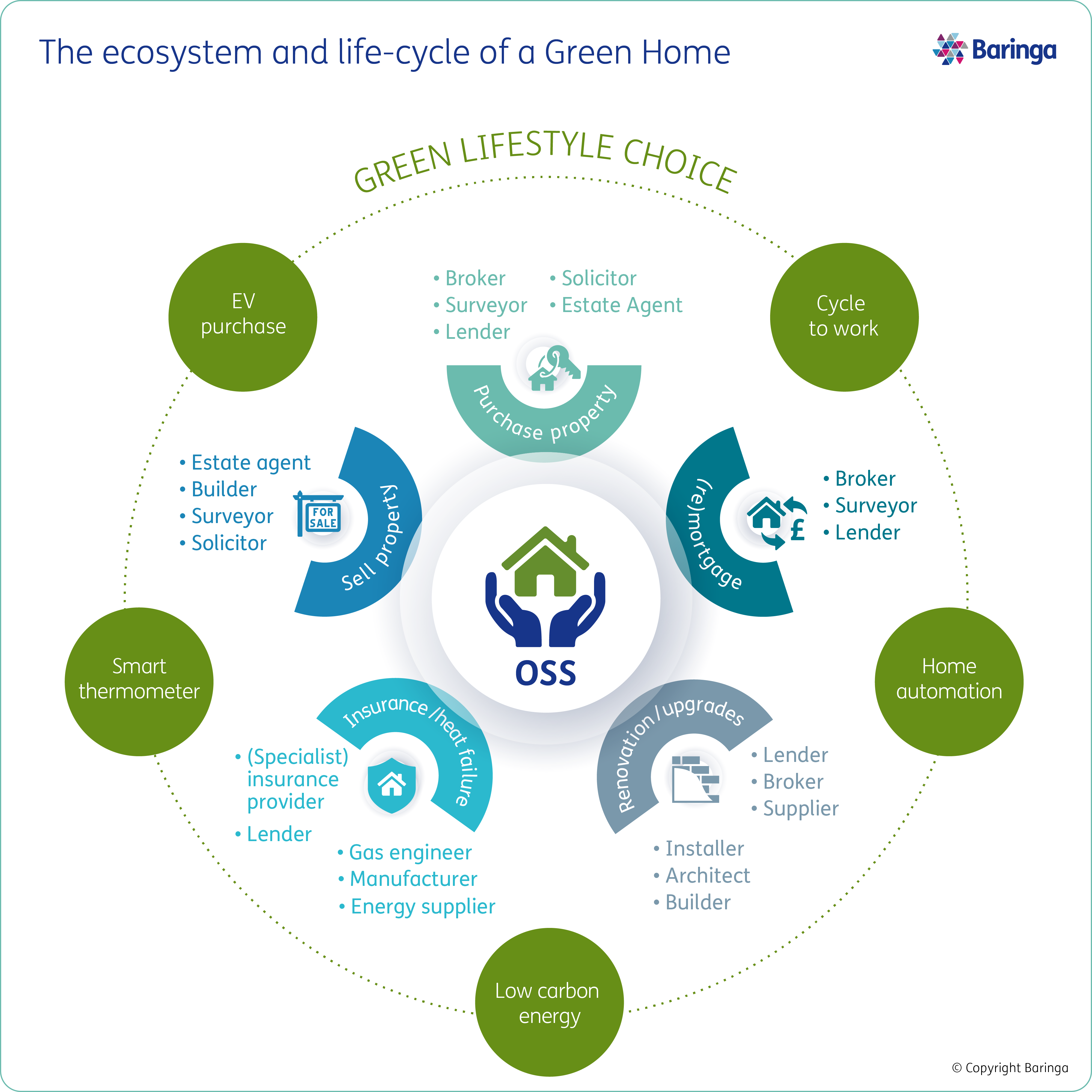
Everyone in the room was keen to drive change. However, this is a challenge in today’s market environment. When asked what could be done to unlock value, three distinct requirements arose:
- Clear and centrally defined judgement on hydrogen to remove current market confusion.
- Increased public awareness campaigns to educate on the importance of engaging with low carbon technologies.
- Increased supply chain investment to remove current and future bottlenecks.
The next steps are clear; industry needs to work together to build simple, easy to access propositions that take the work out of consumer hands.
To deliver this, we need stronger cross-ecosystem partnerships. In the room it was discussed how reputation was a key consideration in the forming of these partnerships: when developing propositions which involve people’s homes, trust is extremely important.
It is a Baringa network
This roundtable was the first of many events where our Green Homes and Businesses Network participants will meet to discuss challenges and share ideas.
Our Experts


Related Insights

Geopolitics is shaping the future of green homes
Green homes are often discussed through the lens of policies, technologies and consumer adoption. But the reality is that they sit within a much wider system shaped by geopolitics, wholesale markets, supply chains and investor confidence.
Read more
Demand-led SMRs: A 'government-last' model to power industrial growth through privately funded SMRs
Drawing on engagement with over 100 potential investors and deep analysis of UK energy market structures, this report sets out a 'Government-last' approach to SMR deployment.
Read more
Simplification, not suspension: why CS3D still matters for executive teams
CS3D timelines have shifted, but the cost, risk and opportunity remain. Learn why executive teams should act now to manage supply‑chain risk and value.
Read more
Carbon capture heats up in Asia: Will it cool down the planet?
Carbon capture’s rising role in Asia’s energy transition
Read moreIs digital and AI delivering what your business needs?
Digital and AI can solve your toughest challenges and elevate your business performance. But success isn’t always straightforward. Where can you unlock opportunity? And what does it take to set the foundation for lasting success?