
How to solve the data paradox in commodity trading
4 min read 11 February 2026
Energy and commodity trading businesses are living with an increasingly expensive paradox: data is recognised as a profit engine, yet firms’ legacy infrastructure is often fundamentally unable to support their future commercial ambitions.
This leads to the frustration of significant untapped potential. Global commodity trading EBIT is projected to reach $115 billion by 2030, growing at double the historical average. How do you correct this data/commercial misalignment and increase your share of that growth?
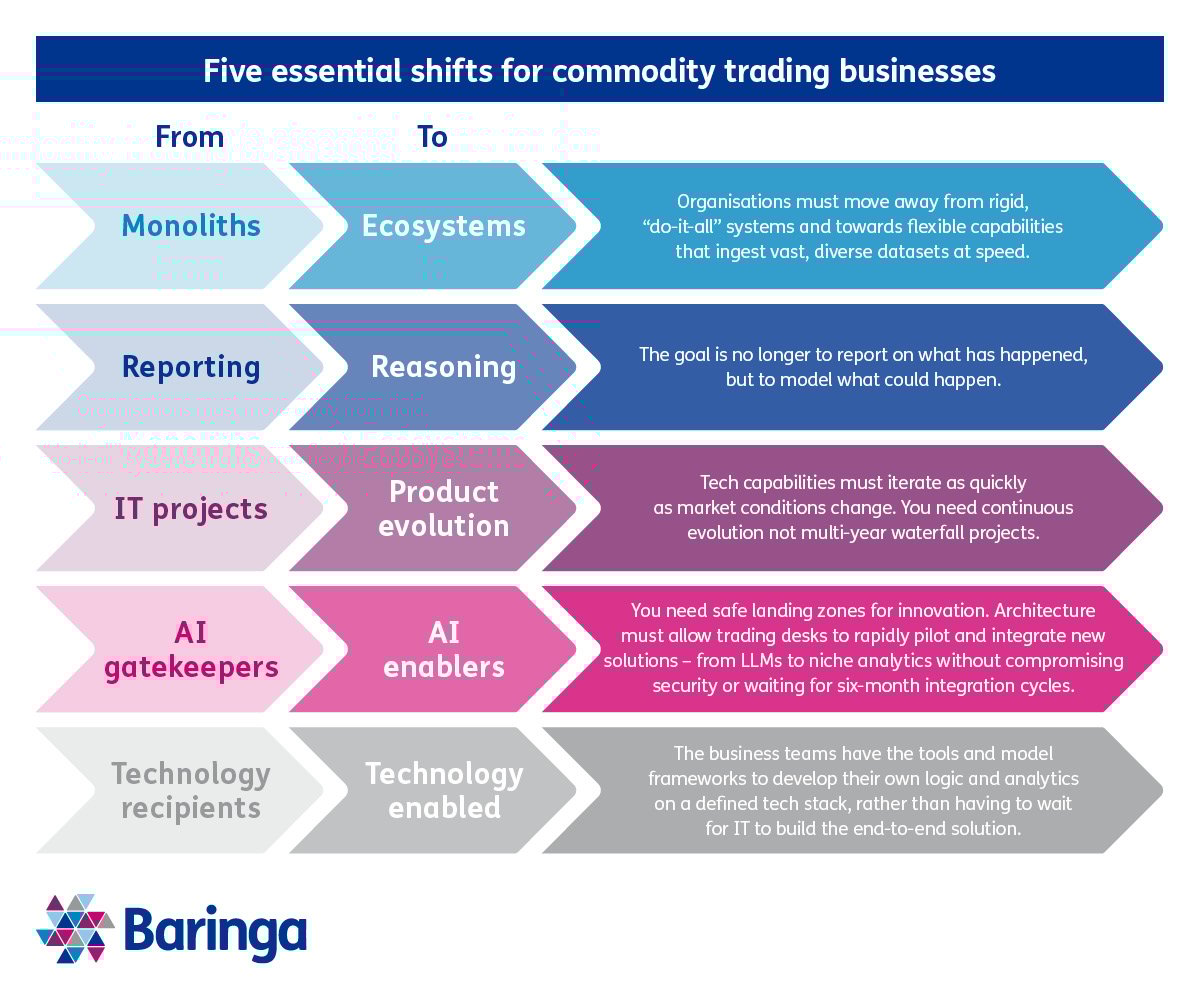
This answer isn’t to buy more (or different) systems, it’s to take a different approach to your underlying data strategy and operating model – pivoting from a focus on stability and control to a focus on speed and experimentation. This requires you to:
- Think beyond ETRMs and align the deal and data lifecycles: Enabling more proactive “in the day” decision making and effective “after the day” settlement.
- Tackle organisational constraints hindering agility: By linking data to commercial outcomes and embedding more flexibility into innovation.
- Bridge the execution gap: By taking an incremental approach to change and a domain-first approach to architecture.
Align the deal and data lifecycles
Energy and commodities data is unique: it’s non-linear, high-volume, and deeply tethered to physical reality. Too many firms attempt to manage this complexity with a monolithic energy trading and risk management (ETRM) system that can’t surface the data needed to address nuanced commercial realities.
Instead, trading organisations need to change their thinking so the data lifecycle aligns with the deal lifecycle.
Go from periodic decision making to “in the day” optimisation
This lifecycle alignment is crucial because the market tempo has accelerated. The sector no longer operates in a pattern of periodic decision making where the morning meeting sets the day’s strategy. Instead, we’re in an era of perpetual adjustment where commodities are shaped by geopolitical shocks as much as supply chain fundamentals – and where volatility is the environment, not an event.
As a result, competitive advantage has moved upstream. Market leaders aren’t the ones who best settle a trade, they’re the ones who best originate it. Value is generated by the ability to predict, optimise, and respond – often intraday, sometimes in real-time.
The traditional trading tech stack doesn’t support this. For two decades, it has been built around monolithic ETRM systems, which are accounting tools designed to manage a trade’s lifecycle after it happens. But for these upstream requirements, you don’t need an accounting tool, you need a proactive decision engine.
Account for “the day after” complexity
In addition to mastering proactive “in the day” decision making, trading businesses need to account for increasingly complex “the day after” work, which is the downstream element of the deal lifecycle. In power markets specifically, the rise of renewables and structured contracts means the settlement process has become incredibly intricate. These aren’t simple spot trades, they require precise data handling long after the deal is signed.
If your data strategy ignores this complexity, you risk leaking the value your traders worked so hard to capture.
Tackle organisational constraints
Developing a data strategy that captures value across the deal lifecycle isn’t about tech, it’s about tackling organisational constraints. To do this, you need to:
- Define what data is needed and when: As part of this, you need to establish clear ownership of critical data assets and directly link those assets to commercial outcomes. This drives the shift away from a culture where people simply implement software and hope it delivers value.
- Take more nuanced approach to risk: You need to adjust the way the business balances security and reliability with the speed traders need. Yes, your settlements, ETRM, and verified PPA contracts need protection. But you also need agility for intraday signals, Python prototypes, and AI pilots. Firms need to move away from a default position where an armed guard is protecting a whiteboard.
- Align IT incentives with commercial drivers: You need IT to be rewarded both for protecting the core and liberating the edge, not just guaranteeing stability and zero error.
When you take these three steps, you drive essential changes to the way the business approaches data.
Bridge the execution gap
It requires skill and domain expertise to restructure your data approach in this way, aligning it to the commercial strategy at the right level of detail.
Standard data methodologies often break down when applied to commodity trading. The deal lifecycle from pre-trade spark spread calculation to physical nomination and final settlement requires a level of domain specificity that generalist tech firms simply don’t have. They can build a data lake, but they don’t understand the underlying assets or cargos to be able to account for actualisations, incoterms, quality and many other complex attributes.
Baringa has a proven track recording implementing successful change programmes for commodity trading businesses because we:
- Translate complexity: We’re one of the few firms that can sit between a Head of Power Trading and a Chief Data Officer and translate for both. We create synergy between commercial ambition and technical execution, ensuring the transformation strategy is owned by the business, not just IT.
- Design domain-first architecture: We understand why a structured settlement breaks a standard SQL database. We design architectures that respect market nuances, ensuring data empowers the range of stakeholders, across the lifecycle.
- Prioritise pragmatism over theory: We reject “Big Bang” transformation approaches that paralyse businesses. Instead, we identify thin, high-value slices of functionality that deliver immediate P&L impact, funding the journey as we go.
The commodity trading sector is moving faster than your legacy data strategy and architecture can support. Let’s put you a step ahead.
We combine unrivalled expertise in commodity trading with proven capabilities in strategy design and technology delivery to enable faster, smarter, and measurable transformation. From revamping operating models to embedding advanced data tools, we align your vision with the tools and skills needed to deliver commercial outcomes.
Contact one of our experts below to learn more.
Our Experts


Related Insights

Navigating the ETRM and CTRM landscape: trends shaping smarter technology decisions
In this article, we demystify the complexity and look at trends that will help you make more informed decisions.
Read more
Adapting to the renewables era: How energy trading organisations can capture maximum value
This article highlights the key steps to success in energy trading’s future, offering a clear path for organisations ready to adapt and lead.
Read more
Commodity market trends: expect diversification, disruption, and strategic shifts in 2026
Commodity markets in 2026: diversification, disruption, and digital transformation. Discover the trends shaping strategies for energy and trading businesses.
Read more
The four-pillar framework that ensures benefit certainty to trading transformation
Our benefits and value framework enables trading organizations to quantify the tangible benefits of transformation upfront.
Read moreIs digital and AI delivering what your business needs?
Digital and AI can solve your toughest challenges and elevate your business performance. But success isn’t always straightforward. Where can you unlock opportunity? And what does it take to set the foundation for lasting success?
 Stay informed
 Energy and resources newsletter