
People are the hidden value lever in consumer goods M&A
5 min read 24 August 2026
How leaders can protect transaction value by engaging the organisation early, deliberately and practically.
Consumer goods dealmaking is reshaping portfolios at pace. Recent activity includes Reckitt's separation of its Essential Home portfolio into Vestacy, Mars' acquisition of Kellanova, Unilever's separation of its ice-cream business into The Magnum Ice Cream Company, and Keurig Dr Pepper's announced acquisition of JDE Peet's alongside plans to create separate beverage and coffee businesses. These moves are not just balance sheet events. They’re asking thousands of people to work differently, make decisions faster, and sustain business performance whilst the organisation around them changes.
That is where value is often won or lost. The strategic thesis may be clear. The synergy case may be well modelled. The programme plan may have precise milestones for Day 1 readiness, TSA exits, technology integration, and cost capture. But if leaders do not give equal attention to people, culture and ways of working, the organisation can become the constraint on the deal rather than the engine of value creation.
Why people and culture determine whether deal logic converts into value
Post-merger integration and separation programmes are inherently complex. Leadership teams are balancing value realisation, customer continuity, regulatory commitments, technology cutovers, operating model changes and cost or revenue synergies. In that environment, the harder-to-measure questions can be pushed down the priority list: What culture are we trying to build? How will we retain talent and capability in the organisation? Which capabilities will matter most in the future business? How will teams understand what is changing, what is staying the same, and what decisions are still open?
Those questions are not soft. They are commercial. In the consumer goods sector, performance depends on the daily execution of distributed teams: sales teams managing customer relationships, factory teams protecting service levels, supply-chain teams reacting to volatility, marketing teams preserving brand relevance, and corporate functions enabling rather than slowing the business. If those teams are unclear, disengaged or pulled into competing ways of working, the value case becomes harder to deliver.
The history of consumer goods M&A reinforces the point. Kraft Heinz demonstrated the risk of pursuing efficiency without sufficient attention to brand investment, growth capabilities, and cultural fit. AB InBev's acquisition of SABMiller showed how difficult it can be to combine different operating models, decision rights and market philosophies at global scale. In both cases, the lesson for today's leaders is not that large deals should be avoided. It is that integration must be designed around the organisation that will actually deliver the value.
Three practical shifts for leaders
1. Replace ‘deal-certain’ communication with engagement that recognises ambiguity
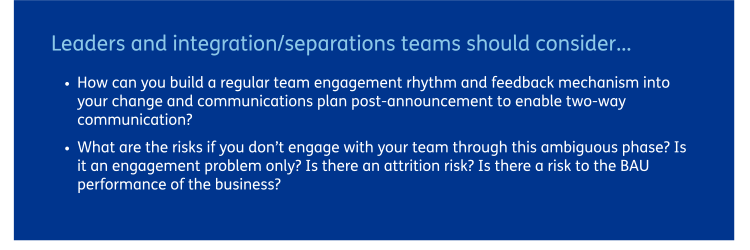
Deal communications are rightly controlled. Disclosure obligations, market sensitivity and employee-relations requirements all matter. But teams within organisations do not wait passively for perfect information. In the absence of clear engagement, people fill the space with speculation: Will my role still exist? Will my factory stay open? Will our values change? Will decisions be made centrally or locally?
The best leaders do not pretend to have every answer. They create a disciplined engagement rhythm that acknowledges uncertainty, explains what is known, clarifies what is not yet decided, and gives people a credible timeline for the next update. That reduces noise and builds trust without compromising confidentiality.
For consumer goods organisations, this needs to be persona-based. A field sales team, a manufacturing workforce, a category marketing team, and a central finance function will experience the same transaction very differently. Each group needs messages that reflect its commercial context, likely concerns and role in delivering the future business.
2. Put culture and human capital into diligence, not just integration
Culture is often discussed once the transaction is already moving. By then, key assumptions may be locked in, leadership decisions may be delayed, and integration teams may be forced to resolve cultural friction under time pressure. That is avoidable.
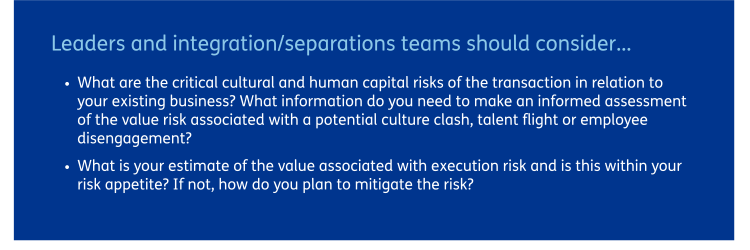
Due diligence should test the human-capital assumptions that sit behind the value case. Leaders should understand where purpose, values and decision-making norms align or diverge; which HR policies and workforce practices will create complexity; which leaders and specialists are critical to retain; and where capability gaps may limit value delivery. This work is not a theoretical culture assessment. It is a way to identify execution risk before it becomes value leakage.
In consumer goods, that assessment should be particularly practical. The organisation needs to know where retailer relationships are concentrated, where manufacturing or supply-chain expertise is scarce, which brand and commercial capabilities are differentiating, and where high-performing talent could be moved into bigger roles in the combined or separated business.
3. Design the target operating model, not just the organisation chart
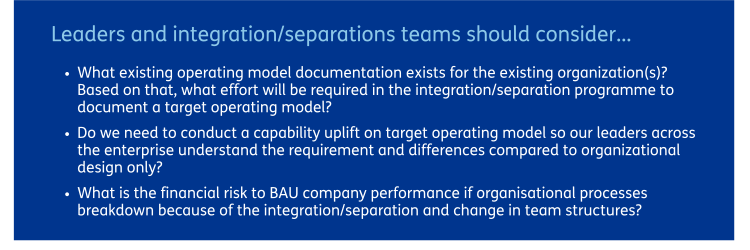
Integration efforts often over-index on organisation design: structures, reporting lines and names in boxes. These are important, but they are not sufficient. People also need to know how decisions will be made, how processes will run, which systems they will use, and how performance will be managed.
A target operating model makes those choices explicit. It connects roles, processes, governance, technology and behaviours into a practical blueprint for how the business will work. For a consumer goods merger or separation, that might mean aligning the go-to-market model, simplifying finance and procurement processes, defining brand and category decision rights, consolidating ERP roadmaps, or deciding where local market autonomy should be protected.
This is where people-centric thinking becomes operational. It gives teams clarity on what will change in their day-to-day work and helps leaders manage the trade-offs between standardisation, speed and local market relevance.
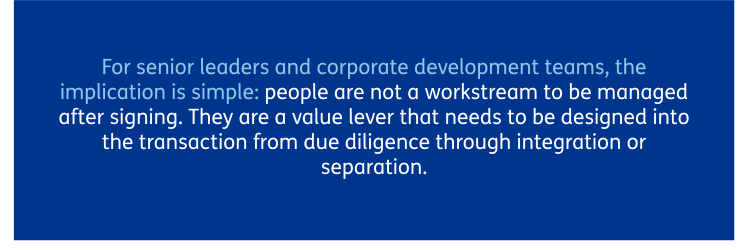
What this means for leadership teams
The most effective integration and separation leaders treat people as a source of value, not only a source of risk. They make three moves early:
- They map the employee groups most exposed to uncertainty
- They test cultural and capability assumptions during due diligence
- They design the operating model with enough specificity for teams to understand how the future business will actually run.
That approach does not remove the complexity of M&A. It makes complexity more manageable. It gives leaders better information, helps employees stay focused on customers and performance, and increases the chance that the transaction delivers the value promised to shareholders, employees, and consumers.
References
- Christensen, C. M., Alton, R., Rising, C., & Waldeck, A. (2011). The big idea: The new M&A playbook. Harvard Business Review, 89(3).
- Milosevic, M., Rau, K., & Steelman, L. (2025, April). A guide to building a unified culture after a merger or acquisition. Harvard Business Review.
- Dan, A. (2019, February). The lesson of the Kraft Heinz nosedive: Radical cost-cutting is out, brands are back. Forbes.
- Donnellan, A. (2025, September 16). Budweiser brews some sobering mega-deal lessons. Reuters Breakingviews.
- Mars Incorporated. (2025, December 11). Mars completes acquisition of Kellanova.
- Keurig Dr Pepper. (2025, August 25). Keurig Dr Pepper to acquire JDE Peet's and subsequently separate into two independent companies.
Our Experts

Related Insights

Supply chain is the licence to grow
As QSR brands expand, supply chain capability is emerging as a key driver of profitable growth, operational consistency, and franchise success.
Read more
The AI-Powered Integration Office
Discover how AI is transforming M&A integration, helping consumer goods businesses accelerate value delivery, reduce risk and improve decision-making.
Read more
Be bold and back your core
What we heard at QSR Evolution 2026 and what our consumer and macroeconomic analysis tells us about where the next wave of QSR growth will come from.
Read more
UK consumer spending outlook H2 2026
UK consumer spending is proving more resilient than expected, but growth is increasingly concentrated among affluent households. Discover who is spending and who is not.
Read moreIs digital and AI delivering what your business needs?
Digital and AI can solve your toughest challenges and elevate your business performance. But success isn’t always straightforward. Where can you unlock opportunity? And what does it take to set the foundation for lasting success?
 Latest Consumer Products and Retail insights
 Exclusive interviews
 Actionable strategies