
Supply chain is the licence to grow
5 min read 1 October 2026
Growth plans are often built around new restaurants, markets, formats, and dayparts. But across the conversations at QSR Evolution, the brands expanding successfully had something less visible in common, they had strengthened the supply chain before asking it to enable more growth. They had changed logistics models, integrated technology or simplified supply networks. Supply chain was not presented as the growth strategy. It was the capability that allowed the growth strategy to work. For QSR brands, supply chain capability is becoming a defining constraint. The question isn’t only whether demand exists, but whether the network can serve that demand consistently and profitably.
Growth exposes supply chain weaknesses quickly
When restaurant growth outpaces the distribution model, the problems reach Customers quickly. Flagship products go out of stock, services times drift, operators turn to local substitutions, and consistency breaks down the estate.
The brands that expanded most effectively had strengthened the network before opening more restaurants. Those that expanded first were left retrofitting supply chain capacity around an estate that had already moved. In a franchised system, that is materially harder because operators may be asked to absorb the cost of fixing problems made elsewhere.
We heard one great example from a major brand at QSR Evolution during their CEO’s fireside chat. He talked of the risks they faced with completing their own final mile delivery services from their bakeries, and how they transitioned to a 3rd party logistics provider which released sufficient capacity in the bakeries to focus on product quality and service. Leveraged 3rd party logistics expertise, the brand could then grow without concerning themselves with a service (logistics) that is not core to their brand mission.
The bigger risk in the next twelve months is under-supply, not over-supply
Our US Consumer Spending Outlook cuts against the prevailing instinct. Most operators spent the last two years managing down, and the reflex is still to protect cash by holding less. But for brands serving the more resilient guest segments, the greater risk is missing the sale or paying for expensive emergency freight to recover it. The temptation to hack supply chain cost (particularly in inventory) to grow the bottom line can undoubtedly make it harder to serve the customer what they want, when they want it. In this environment, availability is a growth lever, not simply a working capital line and therefore the most important focus is not hacking at cost, but ensuring the only investment cost within supply chain is to fuel markets and products that are driving profitability growth.
Fuel is the fastest-moving demand signal you are not using
As we explored in Be bold and back your core, fuel prices can change how often guests travel, where they stop, and which channels they use. Each shift has a supply chain consequence, from drop sizes and delivery frequency to pack formats and pressure on locations closest to the guest. Yet few brands include fuel in demand planning, and fewer still translate it into distribution planning. US consumer spending insights shows why they should.
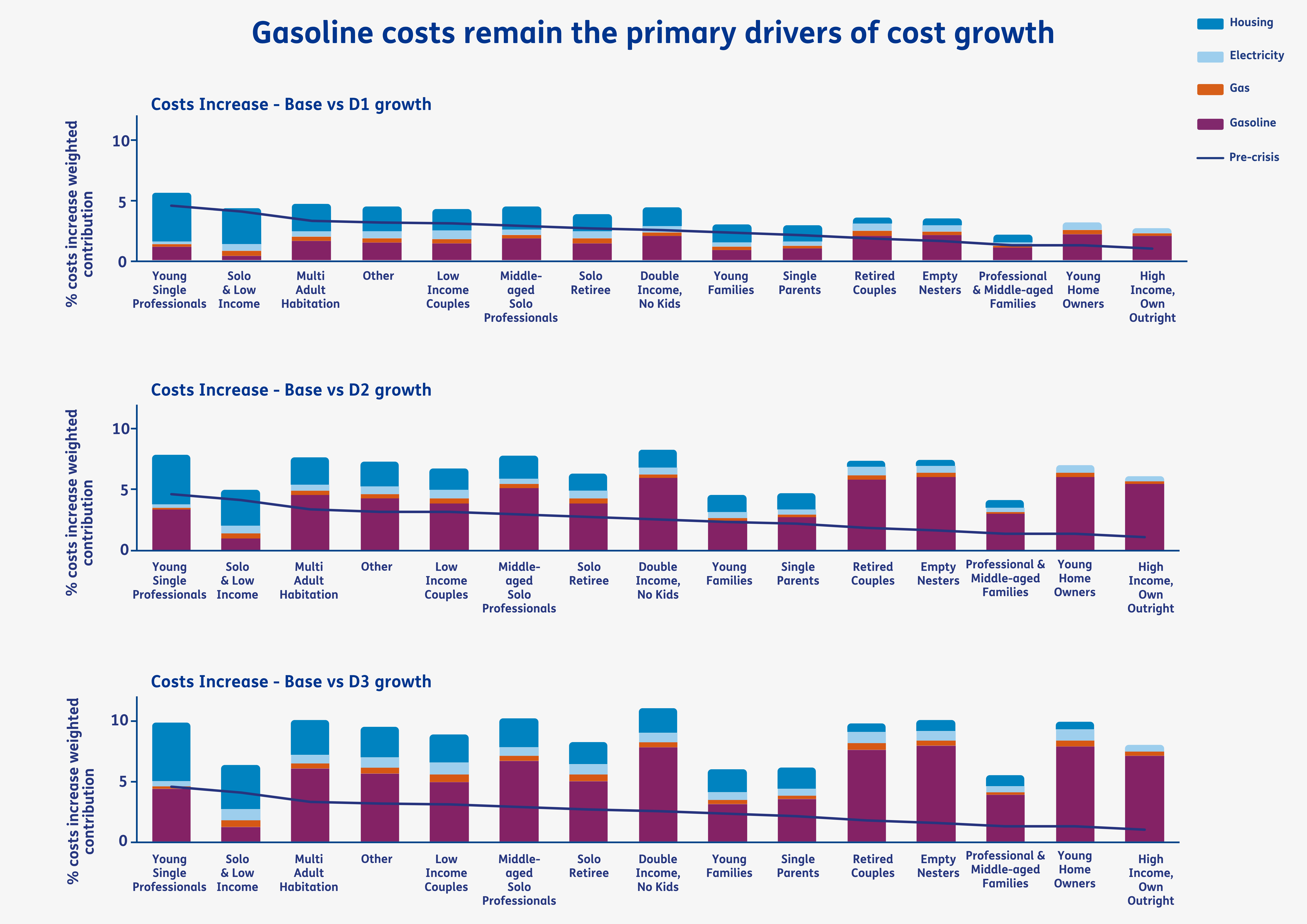
Source: Baringa US Consumer Spending Outlook Q2 2026
Visibility usually stops exactly where the franchise agreement starts
This was the gap we heard most often when the conversation moved past the keynotes. A typical model has the centre aggregating demand forecasts from licensees and operators, submitting a consolidated forecast to suppliers, managing inventory to the licensee's distribution centre, and then losing sight of it entirely.
Store-level consumption, local wastage, substitution, and availability then becomes invisible to the people responsible for delivering the brand's promise. You cannot manage consistency across markets you cannot see or protect the flagship product if you only know what was shipped, rather than what was sold. Closing that gap is rarely a systems problem first. It is a data-sharing conversation with operators, backed by an incentive for them to participate. We’re seeing this as a live issue in a programme we’re currently running, and helping educate the brand leadership and franchise leadership on the criticality of inventory data-sharing and win-win benefit use cases has been crucial in overcoming the barrier.
Energy risk has gone quiet, not away
Our current view is that downside risks have eased rather than disappeared, and energy remains a plausible route by which they could return, particularly in the UK and Europe. For QSR, that risk lands in three places: transport and cold-chain costs, supplier input costs that may result in price increases, and the spending power of the guest sitting at the other end.
The practical implication is structural rather than tactical. Contract length, indexation, dual sourcing on critical products, and the flexibility to move volume between suppliers may matter more than another round of negotiation on unit rates. Brands that treat their critical suppliers as strategic relationships, rather than a tender exercise, are better placed to absorb shocks better.
A world-class example of how brands have dealt with this complexity is in one of our current clients. They made a decision centrally to prioritise strategic buying on a core category on behalf of all of their franchisees operating in each market. In practice, this has meant consolidating supply from 10 suppliers to 2, but in doing so they have leveraged scale to drive price improvements, access to supplier-led innovation investment and worked with the supplier to relocate production so it is closer to the point of consumption.
Supply chain is also where the money for growth comes from
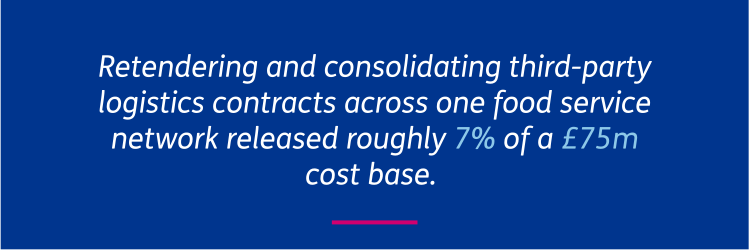
This is a growth story, not only an efficiency story, because the value released can fund expansion. In our own work across QSR and food service, end-to-end supply chain transformation has reduced total supply chain costs by around 10% and put tens of millions of dollars back into franchisee economics. Retendering and consolidating third-party logistics contracts across one food service network released roughly 7% of a £75m cost base. Reducing restaurant-opening lead times by around 30% allowed franchisees to open more locations in the same window, with the same capital.
These are not three separate programmes. They are the same capability being used first to reduce cost and then to increase speed, with the franchisee benefitting from both.
Get the franchisee economics right and the network builds itself
The financial reality operators kept returning to is that franchising becomes more profitable at scale, which makes the franchisee a long-term investor. Anything the brand does to shorten that payback period, including lower landed costs, faster openings, better availability, and more reliable service, can support more locations, faster.
Anything that lengthens the payback period, including hidden distribution margins, restrictive supply arrangements that cost more than they protect, or slow approvals for local sourcing, can quietly cap the growth rate of the entire system.
In our experience, the brands with the strongest new-location pipelines are not necessarily those with the most aggressive development targets. They are the ones whose existing operators are making money and want more stores.
Where to start
The sequencing is not complicated.
- Understand the true end-to-end landed cost per restaurant and per market before you negotiate anything.
- Get visibility past the distribution handover, even partially.
- Put fuel and local demand indicators into your planning.
- Decide which supplier relationships are strategic and treat them accordingly.
- Then use the value released to fund the estate you actually want, rather than the one your current supply chain will tolerate.
Growth will go to the brands that build the capability and capacity before they needed it.
Our Experts


Related Insights

The AI-Powered Integration Office
Discover how AI is transforming M&A integration, helping consumer goods businesses accelerate value delivery, reduce risk and improve decision-making.
Read more
Be bold and back your core
What we heard at QSR Evolution 2026 and what our consumer and macroeconomic analysis tells us about where the next wave of QSR growth will come from.
Read more
UK consumer spending outlook H2 2026
UK consumer spending is proving more resilient than expected, but growth is increasingly concentrated among affluent households. Discover who is spending and who is not.
Read more
Horizons Series: Insights for Navigating What's Next
Explore Baringa's Horizons Series for expert analysis on economic shifts, consumer trends, energy markets, and strategic planning
Read moreIs digital and AI delivering what your business needs?
Digital and AI can solve your toughest challenges and elevate your business performance. But success isn’t always straightforward. Where can you unlock opportunity? And what does it take to set the foundation for lasting success?
 Latest Consumer Products and Retail insights
 Exclusive interviews
 Actionable strategies