
After the applause: where M&A deals actually succeed or fail
6 min read 23 June 2026
When companies announce an acquisition, headlines typically center around the price, the strategy and the promise: scale will grow, new markets will be opened, costs will drop. But once the business event is underway, and the cheering stops, the actual struggle starts.
For all of the hype around M&A deals, research indicates 70–90% of deals fail to meet their strategic or financial objectives. The reason for that is seldom puzzling. They are not so much in the strategy, but in the integration: the culture, the technology, the leadership focus, and the challenge of joining two organizations when they need to know function as a single entity.
Research from Baringa on M&A in the telecoms, media and technology (TMT) sector finds that much of an organization’s attention is put into its deal negotiation, while downplaying the operational work necessary to realize synergies as a result of a completed deal. In other words, integration is where strategy meets the road.
This is the story told by many well-documented cautionary tales. Consider Elon Musk's $44bn purchase of Twitter (now known as X) in 2022. The deal quickly became a textbook example of what happens when disruption instead of thoughtful design drives integration. The platform’s value was rapidly dismantled by mass leadership departures, advertiser exodus and a rapidly disintegrating base that it became a casualty within a few months. The result? X’s market valuation took a significant hit, losing 70-80% of its value.
Or consider the $8.5bn merger of Discovery and WarnerMedia in 2022, that formed Warner Bros. Discovery: a classic case of what happens when two giants with such intricate media portfolios come together under huge debt pressure. CEO David Zaslav offered a solid cost-reduction proposal, but this integration has been characterized by content write-downs, platform rationalization and persistent uncertainty about the joint enterprise’s strategic trajectory. In the years that followed, the combined entity saw substantial erosion in market value, prompting a strategic rethink and, ultimately, a decision to explore a sale. Subsequent interest, including Paramount Global and other strategic buyers, has driven renewed valuation momentum, but this uplift is as much a reflection of competitive deal dynamics as it is of underlying asset strength.
Such stories, while originating from different corners of the economy, share a common thread: that integration is a process that’s consistently underestimated: in complexity, in cost and in the leaders’ attention this requires.
When deals unravel
Many things must be done right at the same time to ensure a successful integration. Commercial continuity, customer retention, regulatory compliance, supplier relationships, workforce planning: the list of stuff - there’s too much to go on and on - is pretty much always agreed on by seasoned integration leaders.
But three things consistently differentiate the integrations that succeed from those that do not: leadership, technology, and culture. There are, of course, many other factors that contribute to success, but these three are the most common fault lines along which value is lost - often quietly and often repeatedly.
1. Leadership: attention that gets distracted.
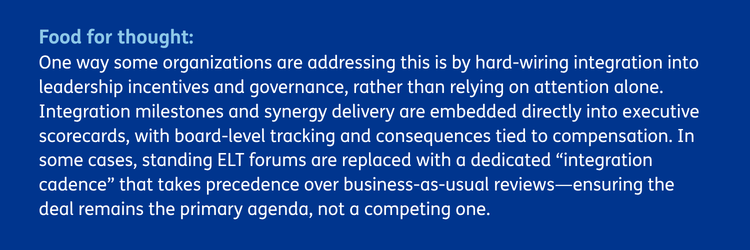
At the heart of many failed integrations is a simple dynamic: leadership attention shifts too quickly once the deal is closed. Executives are released back into the land of business-as-usual and the next strategic priority, and what was once the most discussed topic at ELT level quickly becomes just another program competing for time and focus.
When CenturyLink acquired Level 3 Communications for $34bn in 2017, strategic logic made sense: CenturyLink’s consumer and regional business would have made up a strong competitive challenger with Level 3’s enterprise fibre network. It essentially doubled Lumen’s debt load to about $38 billion, and leadership’s focus shifted to debt management, cost discipline and, most of all, financial survival, rather than integration and growth. The leadership team spent years in an era of asset sales, restructuring and strategic drift, filing for bankruptcy protection in 2024.
2. Technology: a big underestimate and the emerging role of AI.
If leadership attention is often the most obvious impediment to integration, technology is frequently the most underestimated in time, cost and complexity. Execs often believe that consolidating systems is either the only way, or that it is achievable at the same pace that operating models are being redrawn. In the TMT world, with its deep legacy infrastructure, neither expectation is realistic. The deal type has a profound effect on the technology decision. Rationalization is the aim of a scale merger: combine platforms, remove duplicates, eliminate cost. A complementary deal has different calculus as the tech of the acquired entity might be just what was actually acquired, and the drive to consolidate can squander the capability the acquirer paid to have.
The cost of misreading this shows itself in Broadcom’s 2023 acquisition of VMware. Broadcom treated a complementary technology acquisition like a scale rationalization play by rapidly discontinuing products and restructuring the portfolio around a smaller bundle, which alienated its customers and partners. While this has delivered near-term financial gains, it has also created significant strain across the customer base, with some surveys suggesting that as many as 86% of VMware customers are now actively looking to reduce their reliance on the platform, with nearly all evaluating alternatives.
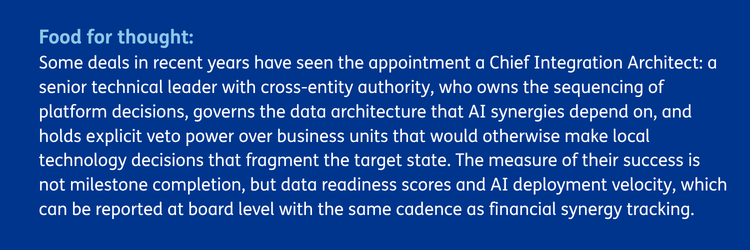
AI is what is making 2026 still messier. ERP consolidation and data migration are still real issues, but AI seems (for many acquirers) the prime way to unlock functional cost synergies at an accelerating pace. The rationales are compelling: AI can help accelerate back-office consolidation in ways that traditionally took years spent rationalizing a headcount. In practice, though, AI-powered synergies are achieved only after data foundations have been clean and integrated—and for acquirers, opaque, siloed data is precisely what they inherit. The implication is clear: AI cannot be treated as a shortcut to integration, but rather as an accelerator, once the fundamentals are in place. Leading acquirers are therefore sequencing their approach, prioritizing data visibility & governance early, while targeting AI at specific, high-confidence use cases where data is already fit-for-purpose.
3. Culture: The unspoken fault line.
And finally, there is culture – the child that is at best underappreciated, and at worst, completely forgotten. Companies so often fixate on the financial results of a merger: cost efficiencies, revenue growth, improvements to their product portfolio, but overlook one of their richest resources: the employee. They often work under the false assumption that differences of working ways will fade away once Day 1 is over and organizational charts have been redrawn.
In reality, those differences can be quite profound: each company comes in with its own assumptions about decision-making, risk appetite and how power is assigned. When all these collide, productivity drops and talent runs. What’s even more complicated is the fact that the cultural problem is different when it comes to the deal. In a scale merger, the cultural task is fundamentally one of harmonization: reconciling how two similar firms are working together, setting right opposing hierarchies, and finding some way to manage the inevitable imbalance between an acquirer's dominance versus the acquired firm’s identity. In a complementary deal, in which two different parties are coming together to create something entirely new, the cultural challenge is more subtle and more dangerous. The acquirer that sets its own operating model over the company it bought because it works differently will kill the thing it just paid for.
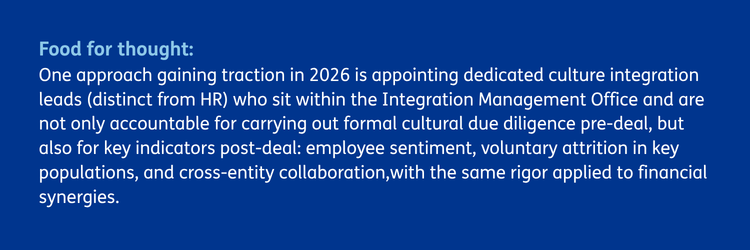
So, the lesson is not merely to “pay attention to culture” as that counsel is too vague to be acted upon. The implication is that performing structured cultural due diligence before the deal closes, not after, with an explicit view of the type of deal. This involves charting decision-making expectations, communication styles, and leadership behaviors across both organizations, determining where friction will most likely occur, and crafting structures that recognize those differences.
The Warner Media and Discovery integration has surfaced exactly this challenge. Two creative organizations, each with deeply held views about content strategy and editorial identity, have struggled to converge on a unified culture. The financial pressures of the deal have accelerated structural changes faster than cultural integration could absorb them, a problem that executives in content-led businesses must take seriously.
Thinking ahead: What does 2026 look like for integration delivery?
Culture, technology and leadership focus aren’t new issues for organizations today. What’s changing is that each of those is growing more difficult to get right, and more costly to get wrong, because the context for M&A integration within the world in 2026 is increasingly stressful, more exacting, more intense, and more unforgiving of the errors that companies have been making for too long.
The incorporation of private equity’s growing involvement has been reshaping the integration brief. More and more TMT deals are PE-backed, and this completely reshapes the integration mandate: time pressures tighten and financial targets and exit horizons become fundamental to many decisions. Cultural preservation and long-term capability building, hallmarks of the best strategic integrations, are becoming harder to get ahead of. PE-backed integrations aren’t worse in themselves, but they’re operating in a different playbook and organizations that try applying a strategic integration model to a financial sponsor deal are optimizing for the wrong outcome. The most effective acquirers respond by explicitly aligning the integration model to the deal thesis upfront: prioritizing speed, cash generation and exit readiness for sponsor-backed deals, rather than defaulting to longer-term capability building that may never be realized within the investment horizon.
AI is rewriting the dealmakers-investors synergy contract. Five years ago, AI was seldom mentioned as a justification for the acquisition; now it is increasingly a part of the investment thesis ahead of closing a deal. Now, this brings new, unique pressure: integration teams are increasingly being asked to perform against an AI synergy promise, during a timeline determined by investor expectations, not operational reality. Companies that stress-test their AI assumptions during due diligence instead of taking on AI assumptions post close do not incur the risks of failed integrations. Leading organizations are addressing this by shifting AI validation “left”, treating data readiness, model feasibility and use-case viability as diligence questions, not post-close discoveries, ensuring that AI commitments are grounded in what can be delivered, and when.
Geopolitical fragmentation is bringing new complexity to integration. Cross-border deals within the TMT industry: national security reviews and different regulatory regimes involving the United States, Europe and Asia on the ground are adding yet new levels of complexity for cross-border deals. Tech stacks constructed to function in a globalized operating environment must be reorganized to meet localization demands that the acquisition wasn’t designed for, but were introduced when the deal was planned. In response, leading acquirers are designing for these constraints from the outset, ringfencing sensitive data, and building region-specific operating models into the integration blueprint, rather than attempting to retrofit compliance once integration is already underway.
The basic principles of integration have not changed, nor have the consequences for getting it wrong. Culture ignored becomes attrition, technology underestimated becomes delay, leadership attention withdrawn becomes drift. What is continuing to change is the environment amplifying each of these risks. Organizations that will consistently create value from mergers in the foreseeable future are likely not those that lock in the best deals. They’re companies that made integration an organizational capability in which the leadership, the structure, the discipline to carry it out deliberately, each new time, has gone.
The deal makes the headlines. It is integration itself that decides if any of it proved worth it.
Our Experts


Related Insights


Consumer market leader: unlocking millions in value with intelligent procurement
How a global leader transformed procurement with an intelligent sourcing platform to boost speed, efficiency and savings.
Read more
Have you built a digital business on a foundation with an expiry date?
After a decade of digital and AI growth, your encryption foundation faces a 2030 expiry date. Leaders must act now to protect long‑term value.
Read more
How smarter commercial strategy delivers 4% margin gains for B2B telcos in a year
The B2B telecommunications market is at a crossroads. As legacy products fade and competition intensifies, the task of staying profitable has never felt more daunting.
Read moreIs digital and AI delivering what your business needs?
Digital and AI can solve your toughest challenges and elevate your business performance. But success isn’t always straightforward. Where can you unlock opportunity? And what does it take to set the foundation for lasting success?
 Latest TMT insights
 Exclusive interviews
 Actionable strategies