
European Winter Gas Outlook 2026-27
Read this Winter Security of Supply article to understand how storage, weather and LNG availability could shape Europe’s gas balance and price risks this winter. This is part of our longer subscriber report, in which we developed weather-driven demand scenarios and assessed the implications for LNG import needs and end-of-winter storage levels.
Thin stocks, a shallow LNG pool and back-loaded weather risk mean price will do the balancing this winter
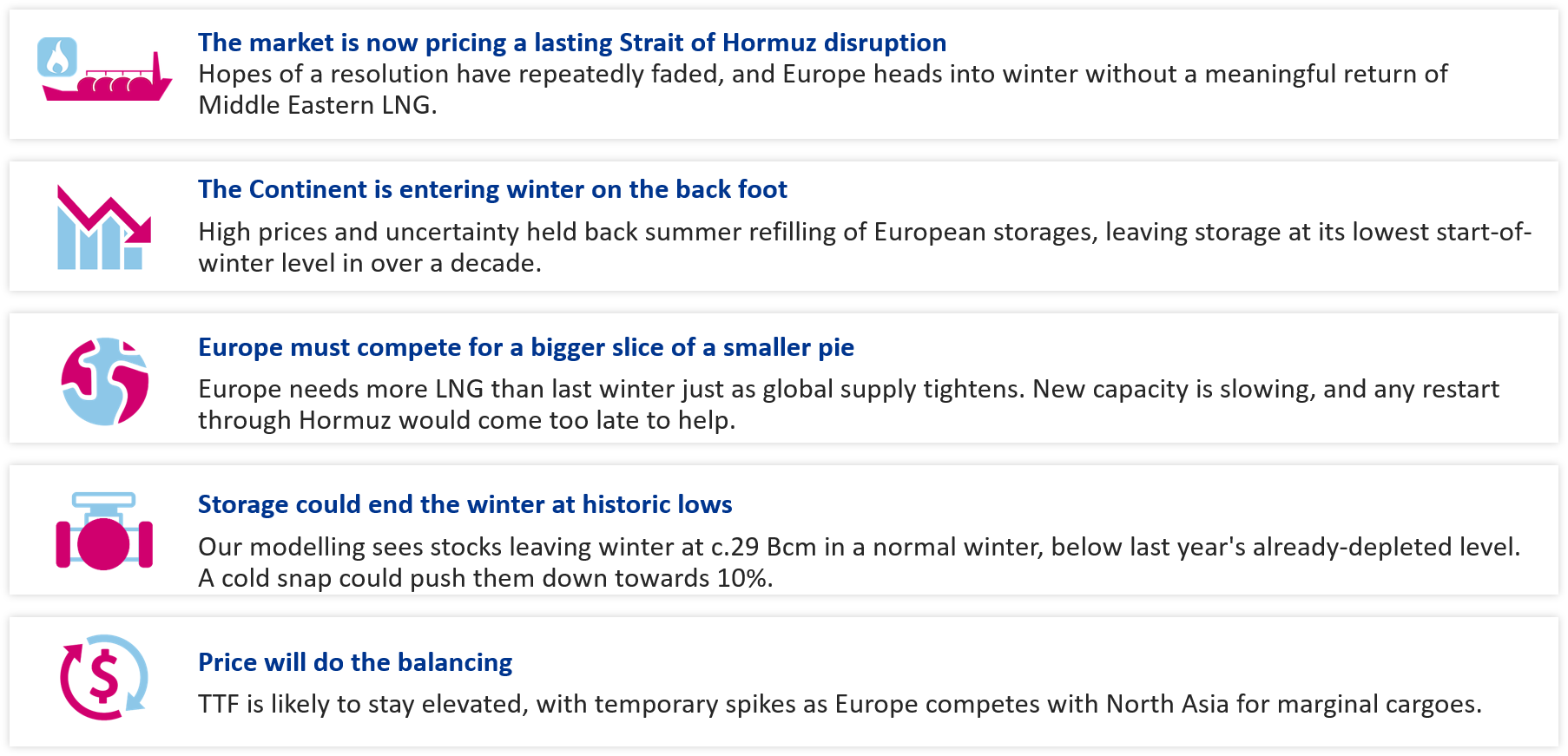
The crisis in the Middle East has caused TTF and JKM prices to rise in 2026; the lack of a resolution has led to a rebalancing of fundamentals around a sustained disruption
European and Northeast Asian gas prices through Hormuz disruption stages (EUR/MWh)
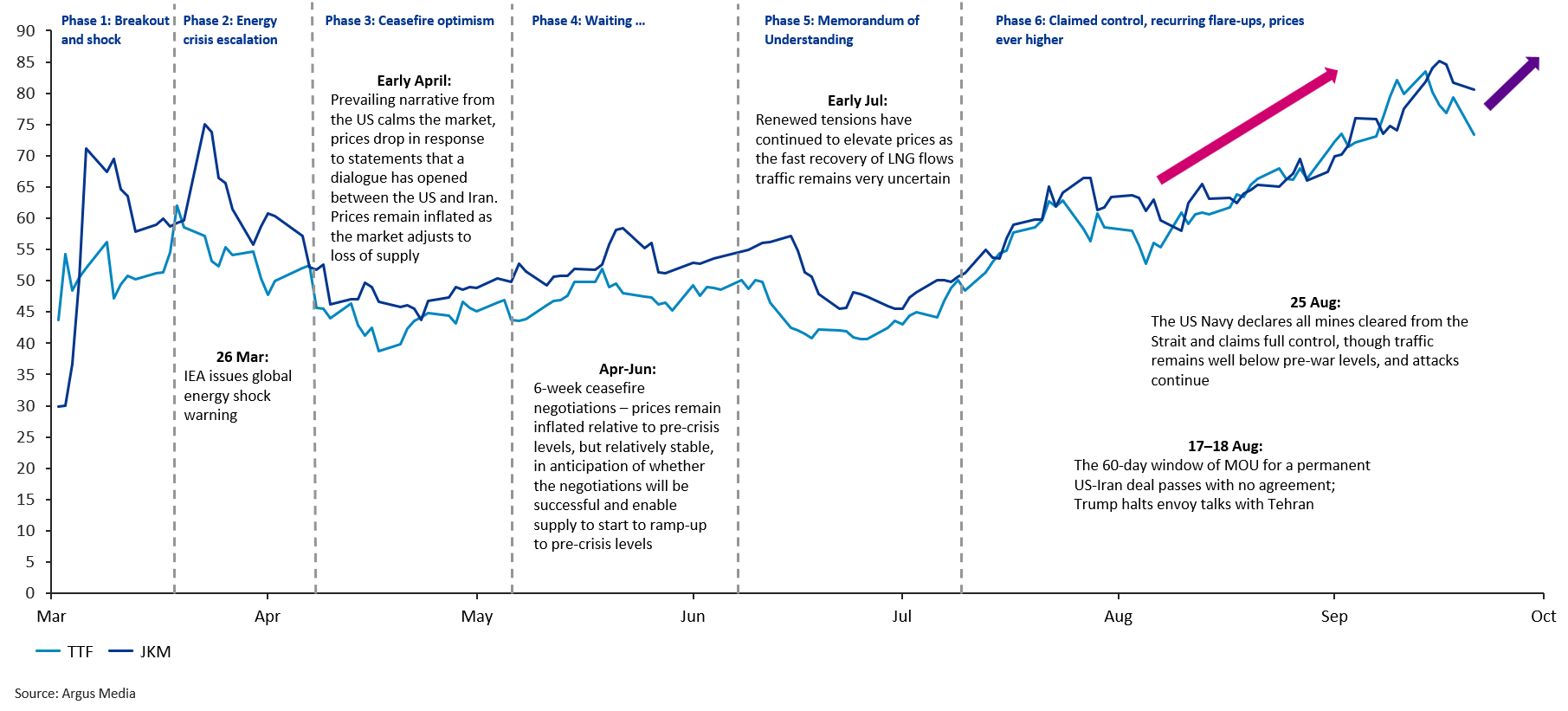
Throughout the crisis month-ahead natural gas prices for TTF (Europe) and JKM (Asia) have moved broadly in parallel, with the conflict transmitting into both European and Asian gas markets through shared supply chain risk channels.
The 28th February attacks and the loss of Ras Laffan in early March triggered the initial price spike. What followed was a sequence of escalations and de-escalations which the market repeatedly priced as a resolution. The 6th April reopening proposal and the 12th April negotiations each pulled prices off their highs; the MoU did so most decisively, promising a return to full pre-war marine traffic within 30 days and removing transit charges for 60 days.
None of these resolutions have held into the long term: over the summer, the further breakdown in relations and further escalations has culminated in the global economy heading into winter without a meaningful resumption of flows. This has shifted the market from pricing a temporary disruption to pricing a sustained one.
Despite the scale of the disruption, several short-term factors worked to limit price escalation across global commodity markets
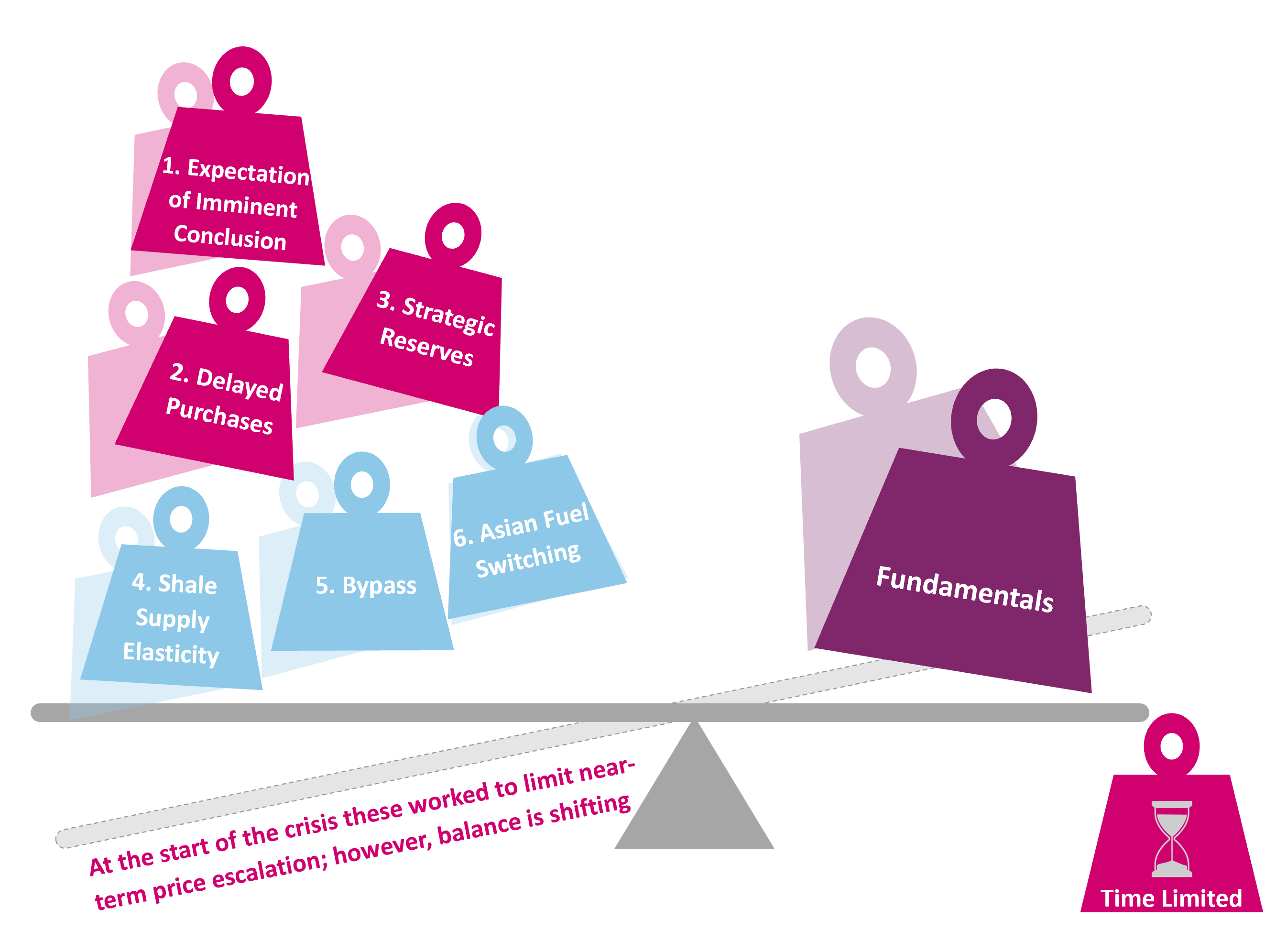
Strategic reserve releases, delayed procurement activity and expectations of an eventual de-escalation in the conflict all reduced immediate price pressure. At the same time, structural changes in the global energy system, including greater US shale responsiveness, the use of by-pass infrastructure (for oil) and fuel switching in Asia, have helped dampen the extent of the supply shock. However, many of these mitigating forces are inherently temporary. As the crisis has gone on, the impact of these forces have started to wane; driving upward pressure on wholesale prices as fundamentals start to dominate.
Europe is entering the 2026-27 winter with the lowest storage levels in over ten years, following LNG supply constraints and high import prices since March 2026
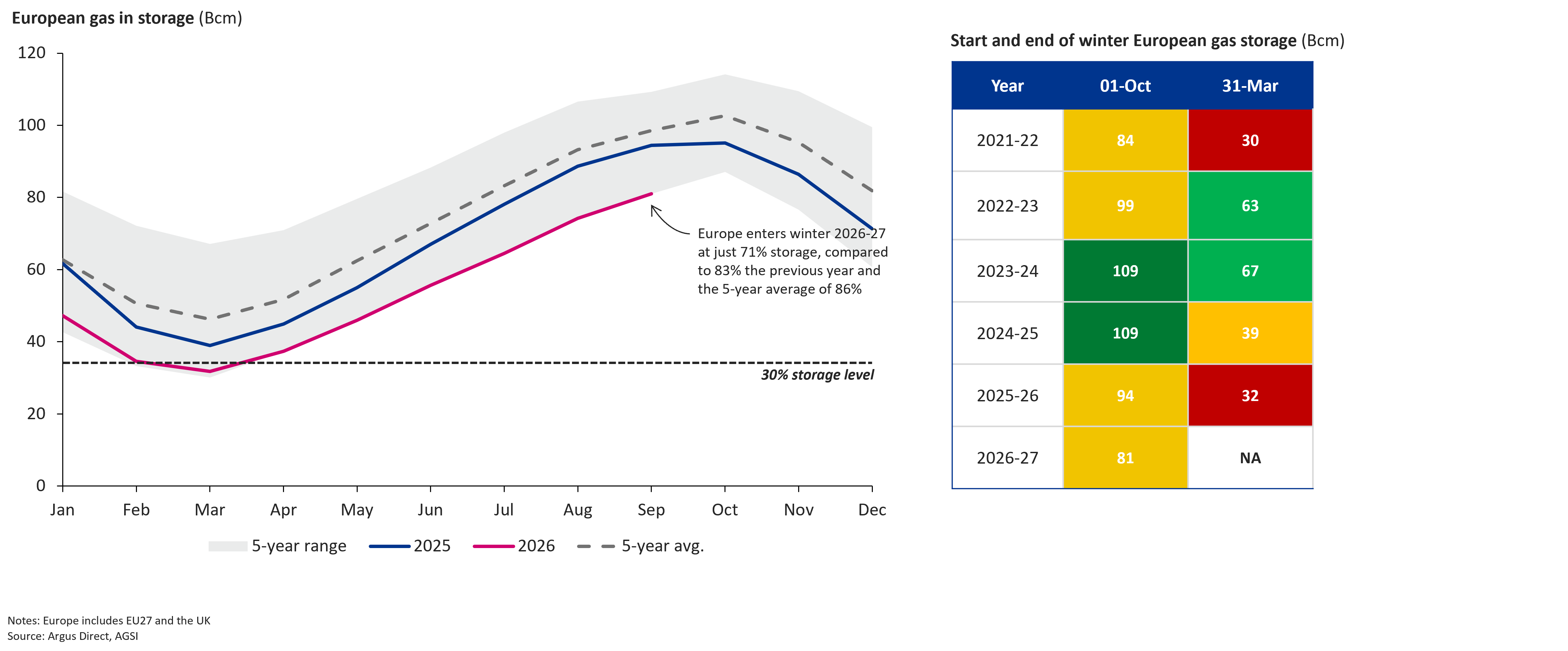
The disruption to LNG supply through 2026 has driven both TTF and JKM prices to their highest levels since the 2022-23 winter. With significant uncertainty around the potential pace of a resolution to the conflict in the Middle East and the ramp-up of LNG flows, the appetite for purchasing gas for storage injection across the summer has been suppressed. European gas storage as of the 1st of October is at its lowest level in over ten years, sitting at just 71% compared to the 83% of last year which in itself was considered a low year for storage.
The table above shows that, despite coming out of last winter with depleted storage, storage injections this year have not increased to bring storage fill back to typical levels. The contrast is clear when compared to 2022, in which comparably low early-year storage was well-supported by injections across the year (30bcm, compared to the 99bcm in storage by the following winter), despite the disruption to pipeline supply from Russia.
Europe has absorbed a substantial part of LNG supply loss since March 2026, but imports since August are in line with last year as storage refilling becomes a priority
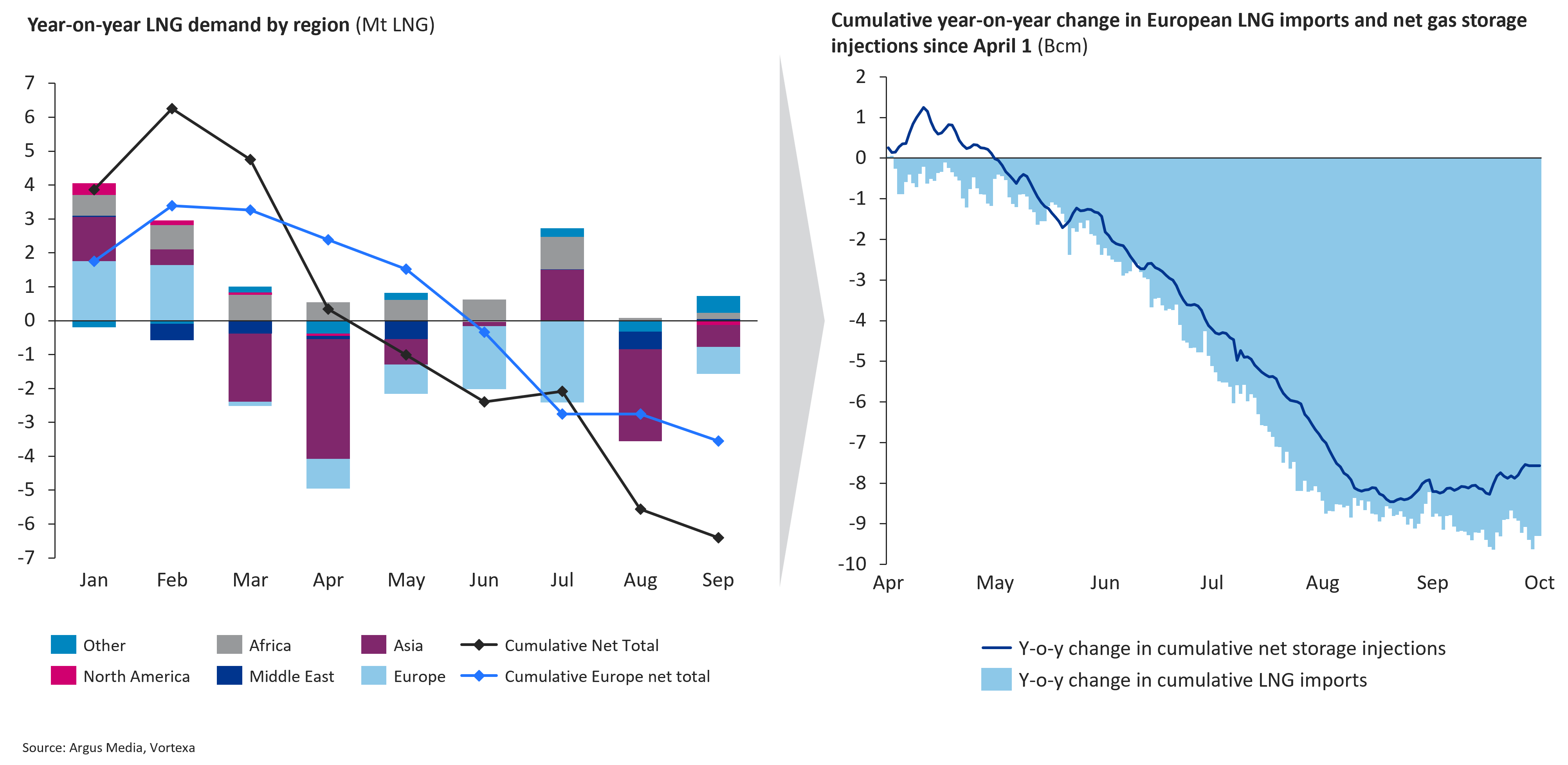
LNG produced in the Persian Gulf represents about 20% of global supply. LNG supply from Jan-Sep 2026 is down 38 million tonnes compared to the same period in 2025, despite supply increases from other regions- notably North America. As can be seen from the chart on the left, Asia and Europe have absorbed the bulk of this lost supply, with year-on-year European LNG imports across the typical storage injection period falling significantly.
The chart on the right demonstrates the direct impact on storage injections, with the cumulative year-on-year change in storage injections tracking in line with the change in LNG imports. The flattening of the profile from August has occurred as storage refilling becomes more of a priority, though the deficit compared to storage injections last year is evident, and far too large to be mitigated.
European storages entered winter 15% lower than five-year average; additional LNG supply will be needed to offset lost Middle Eastern volumes despite stable demand.
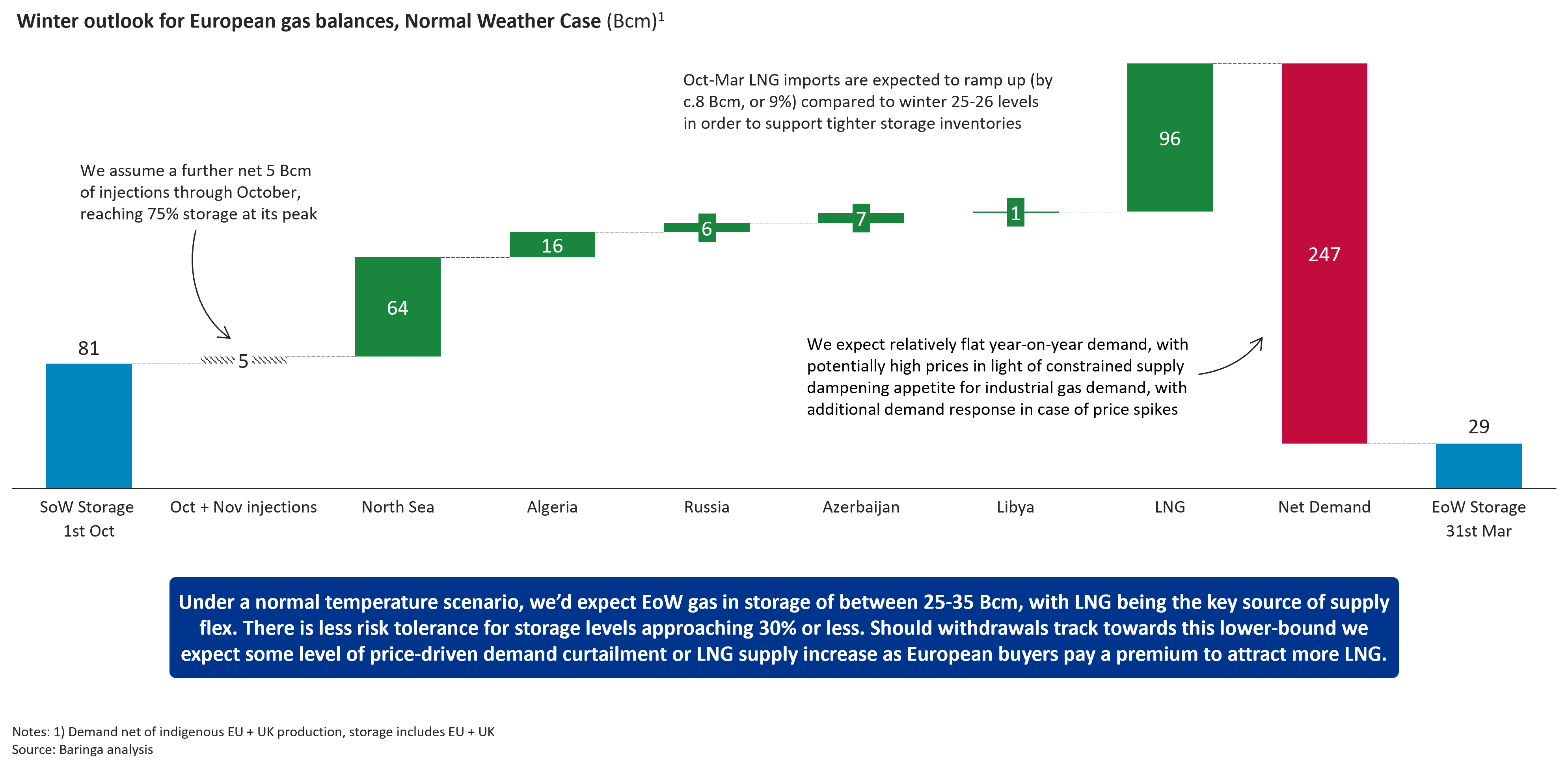
As we saw above, Europe’s start of winter storage sits at 81Bcm or around 71% full, compared to the 5-year average of 86%. We’re anticipating a further 5Bcm of net additions across October and November, likely leaving most of Europe short of the 90% December storage target set by the EU (although the current rules have higher flexibility on when and how the target is met). Supply from North Sea production as well as pipeline sources in North Africa and Azerbaijan is expected to hold steady compared to previous years, with the continued phase out of Russian pipeline supply leaving only volumes arriving in Europe via the Turkstream pipeline this winter. Winter demand overall is expected to decrease compared to last year, though this is driven by reduced heating and industrial demand, as gas for power is currently higher than last year due to low availability of renewables, especially from hydropower. LNG imports will need to increase to account for the low start of winter storage and Russian supply losses, with end of winter storage expected to sit around 29Bcm, 2.5Bcm lower than last year.
Europe’s reliance on LNG as a marginal supply source leaves it exposed to global market dynamics, having entered the winter with notably low storage inventories
- Europe has entered winter in a vulnerable state: After significant disruption to the global gas market throughout 2026, Europe is entering the 2026-27 winter with notably lower storage levels than have been carried into previous winters. Assuming typical patterns of supply and demand, inventories could threaten to reach a historic degree of depletion, especially in the event of increased demand brought on by cold weather events.
- There is limited scope for significantly higher year-on-year LNG imports: As the marginal source of gas supply for Europe, LNG would typically be relied upon to provide a buffer against gas storage depletion. However, with continued supply disruption in the Middle East and slower capacity addition rates from new projects, LNG supply increases this winter are expected to be relatively modest.
- Should Europe need additional LNG volumes, there is risk of competition from Asia: As the closure of the Strait of Hormuz has affected gas markets on a global scale, it creates an increased risk of competition between LNG-reliant markets such as Europe and North Asia. Should a spike in European demand coincide with strong demand requirements in Asia, there is a risk of price competition for marginal cargoes, driving the spot price (eg JKM, TTF) much higher. With spot LNG only making up around 30% of Asian LNG supply, buyers there are typically prepared to pay very high prices for necessary cargoes, which would drive TTF up at times of inter-basin competition.
- Significant threats to European storage may trigger TTF price spikes to attract LNG: If and when European storage inventories drop to lower levels, particularly should this occur mid-winter, Europe is likely to start looking to secure LNG cargoes even in the face of price competition from other markets. Attracting cargoes to Europe will incur a TTF price response, which may also result in some demand curtailment, especially in sectors exposed to energy prices.

Find out more about the Gas Market Service
Access long-term gas demand forecasts, LNG market outlooks, gas price projections and quarterly market analysis to help investors, utilities, developers and large energy users make better strategic decisions. As gas prices remain a key driver of European power prices, even with rapid renewable buildout, this service is essential for a deeper understanding of global gas, and the gas and power price outlook.
Contact our gas experts


Is digital and AI delivering what your business needs?
Digital and AI can solve your toughest challenges and elevate your business performance. But success isn’t always straightforward. Where can you unlock opportunity? And what does it take to set the foundation for lasting success?
 Stay informed
 Latest E&R insights