
Short-term squeeze or seismic shift - what does the largest oil supply crisis in history mean for your business?
19 June 2026
Key takeaway: A US-Iran framework deal has been signed and the Strait of Hormuz is set to reopen in principle, but a signature does not move barrels. Markets have priced a resolution. Physical reality has not caught up yet. The gap between the two is where your strategic risk lives.
What is the Hormuz crisis and why does it matter?
The disruption to oil and gas flows from the Persian Gulf represents the largest energy supply shock in modern history, exceeding the 1973 Oil Embargo, the Iran-Iraq War, and Iraq's invasion of Kuwait in terms of affected global supply. At its peak, approximately 16% of global oil supply was disrupted as crude and LNG shipments through the Strait of Hormuz effectively ground to a halt.
A US-Iran framework agreement has now been signed, with the Strait due to reopen in principle by 19 June. Oil settled at its lowest level since early March on the news and equity markets rallied. Yet the speed of the relief rally raises its own question: are markets pricing out the risk too quickly, just as they earlier priced in the disruption too slowly?
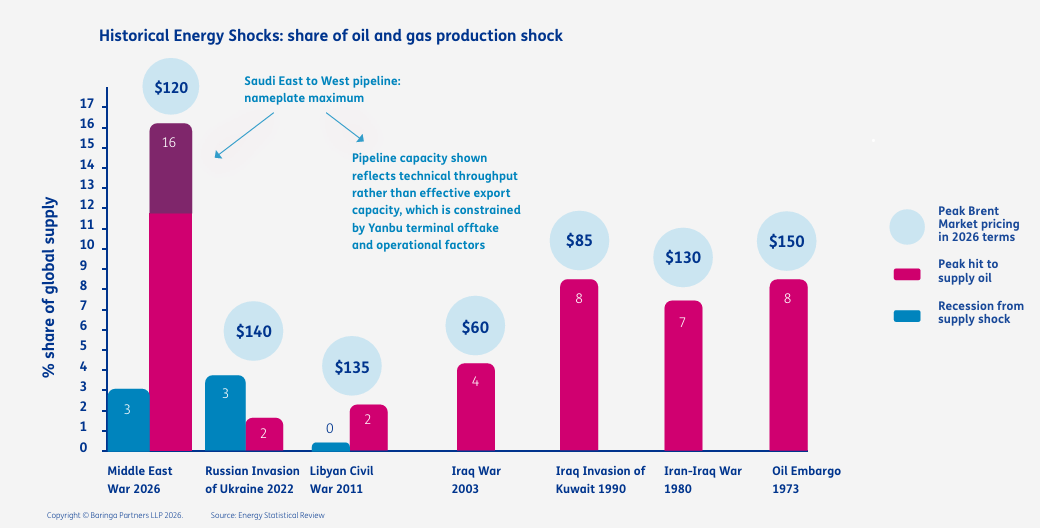
Despite being the largest supply disruption on record, peak oil prices only briefly reached around $120/bbl, remaining below the peaks seen in several previous, smaller crises. This disconnect between the scale of supply loss and market pricing is one of the defining features of the current shock.
Why have prices stayed lower than expected, and why might that change?
Several short-term factors have limited price escalation: strategic reserve releases, delayed procurement activity, expectations of de-escalation, greater US shale responsiveness, lower energy intensity across advanced economies, and fuel switching in Asia.
However, many of these forces are inherently temporary. Delayed purchases eventually return to market. Strategic reserves are finite. Expectations of rapid resumption become harder to sustain as disruption persists.
Meanwhile, global oil inventories are projected to fall toward operational stress levels by the end of June 2026 and approach the operational floor (the minimum required to keep pipelines and refineries functioning) by the end of September 2026, based on our analysis of Vortexa data. At these levels, inventories lose their role as a market buffer and physical fundamentals increasingly dominate price formation.
The agreement itself sharpens the risk. The US has set the nuclear question aside, pushing it into a 60-day negotiating window, in order to secure the reopening of the strait. That choice front-loads the energy relief but leaves the conflict's hardest issue unresolved and explicitly time-limited.
"Markets continue to price a rapid resolution, not the reality of the supply shock. If volumes fail to return soon, a sharp repricing becomes increasingly likely."
Caspian Conran, Lead Economist
What are the inflation and growth risks if markets reprice?
Inflation expectations have risen across major economies, but the overall repricing remains moderate given the scale of the shock. Markets continue to imply a temporary inflation impulse rather than a prolonged inflationary cycle.
Our modelling suggests the picture changes materially under fundamentals-driven oil pricing. A move from current market pricing (around $90/bbl) toward $140-150/bbl would imply significantly higher inflation and unemployment across all major economies, with more import-dependent markets, particularly in Europe, substantially more exposed.
Signs of weakening business activity are becoming more visible. While manufacturing PMIs remain surprisingly stable, services surveys point to a broader loss of momentum, most evident in Europe, Japan, and Australia. Growth forecasts have been revised lower, but the scale of downgrades remains modest, reflecting the continued market assumption that the shock is manageable and ultimately temporary.
Financial markets currently price a delayed easing cycle rather than a return to monetary tightening. However, our modelling suggests that under fundamentals-driven pricing, the rates needed to keep inflation at target would require a significant tightening cycle across major economies. Bond yields have already begun rising across all maturities, most pronouncedly at the long end, pointing increasingly toward a stagflationary macro backdrop.
Why is the UK more exposed than most?
The UK enters this energy shock with one of the weakest sovereign financing positions in the developed world. Ten-year gilt yields remain above those of every other major G7 economy, reflecting weaker growth expectations, inflation persistence, fiscal concerns, and a continued political risk premium.
UK households are also the second most exposed globally to rising energy costs among major economies, with utilities accounting for approximately 6.5% of take-home pay (behind only Japan at around 7.5%). This compares with roughly 5% in the US, 4% in Germany, and 3.5% in Australia.
Governments across major economies now have materially less fiscal space than in previous crises. The extraordinary fiscal looseness that followed the pandemic is reversing, forcing tighter fiscal settings even as economic momentum slows. Unlike 2008 or 2020, governments have limited capacity to shield households and businesses from sustained energy cost rises without risking further deterioration in sovereign financing conditions.
Our consumer spending model highlights how sensitive UK demand remains to sustained energy price strength. Under a sustained higher energy price environment, UK consumer spending growth could turn negative (-0.19%), with a more severe downside scenario pushing toward recessionary conditions. The impact is highly asymmetric: single parents, graduate and young professional renters, solo and low-income households face the sharpest squeeze on disposable incomes.
By contrast, the US avoids a major contraction due to Henry Hub's insulation from global markets and the prevalence of 15-year mortgages, which shield households from rate shock relative to the UK.
How is sector performance diverging across regions?
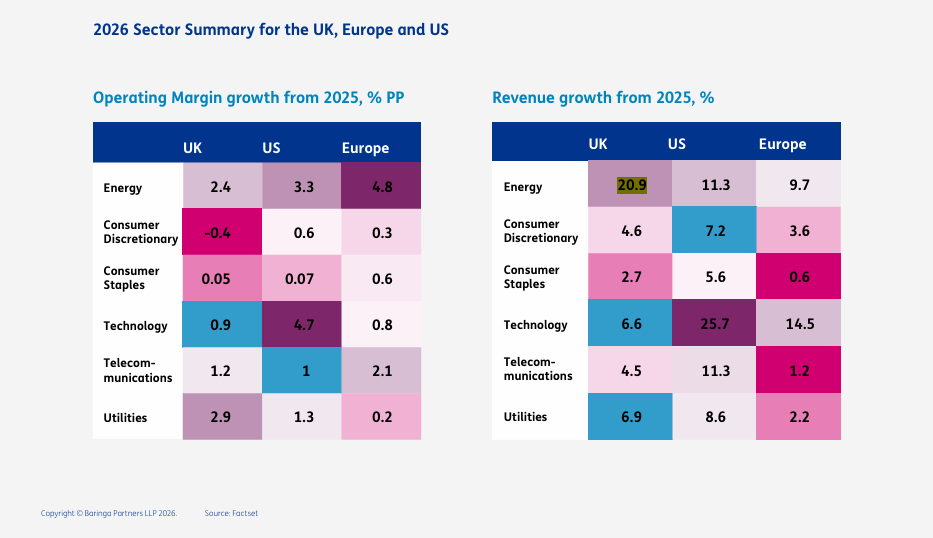
Energy is the standout performer across all regions, supported by higher commodity prices. US Technology remains firmly in a strong position with 25.7% revenue growth and expanding margins, supported by structural investment trends. Defensive sectors such as Utilities and Telecommunications have remained comparatively resilient.
By contrast, Consumer Discretionary is the clearest area of deterioration across the UK and Europe, as higher input costs and pressure on household incomes feed through into margins and demand. The UK sector outlook has become more polarised, with defensive and energy-linked sectors outperforming while consumer-facing sectors weaken.
What comes next: scenarios to plan around
The central macroeconomic risk is no longer simply the disruption itself, but the durability of the agreement and the pace of physical recovery. Current market pricing assumes not only a clean reopening but a prompt return of volumes and a smooth path through the nuclear negotiations.
Reopening in practice depends on mine clearance, the rebuilding of war-risk insurance capacity, tanker re-routing back through the Gulf, and the restart of fields shut in for months. Oil wells are not switches, and reservoir and wellbore conditions deteriorate during prolonged shut-ins.
If field restarts disappoint, if mine clearance and insurance capacity rebuild slowly, or if the 60-day talks stall and the ceasefire frays, a renewed tightening in oil and gas markets could trigger a materially sharper stagflationary downturn than is currently reflected in financial markets, arriving into markets that have already moved on.
"Most businesses have been waiting this out. The ones that are planning for continued disruption are already in a stronger position."
Ellen Fraser, Associate Partner and expert in Energy and Resources
Frequently asked questions
What is the Strait of Hormuz oil supply shock?
The 2026 Middle East conflict created the largest energy supply disruption in modern history, affecting approximately 16% of global oil supply. Crude and LNG shipments to destinations outside the Persian Gulf effectively halted for several months.
Has the US-Iran deal resolved the energy crisis?
A framework agreement authorises reopening, but physical restoration depends on mine clearance, insurance rebuilding, tanker re-routing, and field restarts, a process that could take weeks to months. Markets have priced a full recovery; physical reality has not yet delivered it.
What is the stagflation risk for the UK in 2026?
The UK is particularly exposed due to higher energy import dependence, elevated household utility costs, limited fiscal flexibility, and the highest government borrowing costs in the G7.
When could global oil inventories reach critical levels?
Baringa analysis projects operational stress levels by end of June 2026 and the operational floor by end of September 2026, if Gulf flows do not recover.
Which sectors are most resilient in 2026?
Energy, Technology (particularly in the US), Utilities, and Telecommunications. Consumer Discretionary is the clearest underperformer in the UK and Europe.
Our Experts


Related Insights

How water resilience will shape the future of data centres
Digital growth meets water scarcity: Future data centres rely on managing water–energy trade-offs, securing non-potable supply, and building resilience.
Read more
The role of the state in the Great British energy market
What is the state’s role in the Great British energy sector and how could it be extended to support decarbonisation objectives?
Read more
Are we facing a slowdown in corporate profitability?
Discover eight key strategies to supercharge value creation and mitigate the ongoing squeeze on corporate profitability.
Read moreIs digital and AI delivering what your business needs?
Digital and AI can solve your toughest challenges and elevate your business performance. But success isn’t always straightforward. Where can you unlock opportunity? And what does it take to set the foundation for lasting success?
 Latest insights
 Exclusive interviews
 Actionable strategies