
Collaborative contracting in capital projects: a guide for asset owners
3 min read 16 June 2026
What is collaborative contracting in capital projects, and when should asset owners use it? This guide explains when collaborative contracting is most effective, the different models available, and the key decisions asset owners must make to ensure successful implementation.
Capital investment across regulated energy networks and water, and oil & gas is intensifying. Regulators and asset owners are committing large sums to greenfield development, brownfield modifications, asset replacement and capacity expansion while operating live systems.
These programmes face persistent delivery risk. Scope uncertainty increased regulatory risk transfer, constrained supply chains, commodity price volatility and complex interfaces are now routine. Safety cases, environmental and permitting and assurance requirements add further pressure. In this context, contracting choices directly affect board confidence on cost recovery and delivery outcomes.
Collaborative contracting has gained traction because it addresses these risks differently. Rather than pushing uncertainty down the supply chain, it aligns incentives, brings capability in earlier and creates joint mechanisms to manage cost, schedule and risk. For asset owners and developers, the question is not whether collaboration is “better”, but when, where and how it supports improved outcomes.
What is collaborative contracting in capital projects?
Collaborative contracting is not a single contract form. It is a family of commercial and delivery models that deliberately rebalance risk, transparency and decision‑making between owners and suppliers.
At its core, collaboration replaces defensive behaviour with engineered alignment. This is achieved through early supply chain involvement, shared governance, open cost and schedule controls, and incentives linked to asset and portfolio outcomes rather than individual contractual positions.
This approach is increasingly reflected in UK public-sector guidance, including the Construction Playbook, which promotes early engagement, appropriate risk allocation and contracting strategies that prioritise outcomes over lowest price. For regulated asset owners, this aligns closely with expectations around value for money, innovation, auditability and demonstrable control.
Collaboration is therefore not about goodwill. It is a commercial and governance choice. When designed well, it strengthens assurance and reduces late-stage intervention.
The spectrum of collaborative options
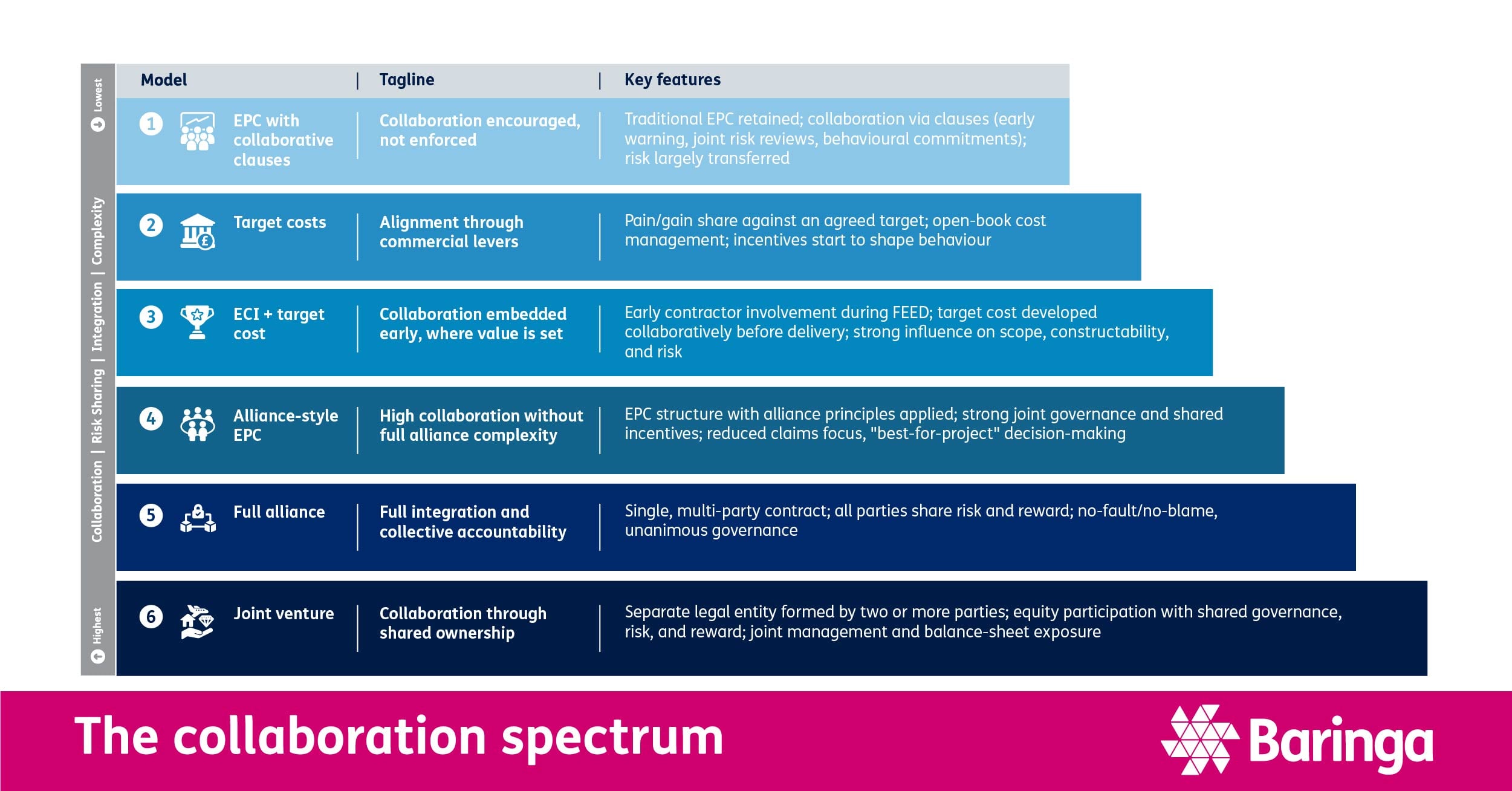
Collaboration is not binary. Asset owners can select from a spectrum of models with different implications for mobilisation time, governance burden, risk exposure and regulatory treatment.
At the less integrated end are traditional contracts with enhanced collaborative mechanisms. At the more integrated end are alliance and multiparty models that fundamentally change how risk and reward are shared.
A practical spectrum includes:
- Lump sum with collaborative clauses
Traditional lump sum structures with joint risk management and behavioural commitments. These preserve familiar governance and are often easier to assure, but offer limited transparency.
- Target cost with pain/gain share
Open‑book delivery with financial incentives linked to cost, schedule and performance. Owners gain visibility and influence, but must actively manage commercial and cost controls.
- Early contractor involvement plus target cost
Suppliers shape scope, sequencing and constructability before execution commitment. This improves confidence in brownfield and complex work, but extends pre‑award phases.
- Alliance‑style EPC
An EPC framework enhanced with shared incentives and joint governance. Risk transfer is softened and owner capability requirements increase.
- Full alliance or multi‑party agreement
Integrated delivery with shared risk and reward and a strong “best for project” focus. These models demand mature governance and explicit alignment with board and regulatory expectations.
- Joint venture
Structural alignment through shared ownership and governance, typically reserved for very large or strategic investments.
For boards and sponsors, the trade‑off is straightforward. Greater collaboration can reduce execution risk and rework, but it requires earlier commitment, enhanced supply involvement and more active oversight.
When should asset owners use collaborative contracting?
Collaborative models are most effective where uncertainty and interface risk dominate, different parties are best placed to manage that risk and learning can be retained across programmes.
They are particularly suited to situations where:
- Scope is incomplete or expected to evolve, such as major multi £bn developments (scale enhances complexity), brownfield tie‑ins, life‑extension work or early enabling projects
- Interface risk is material, including live operations, outages, constrained access or multiple delivery packages
- Market capacity is tight and suppliers are unwilling/unable to price lump‑sum risk sustainably
- There is a repeatable portfolio, promoting innovation and the ability for performance to improve over time
By contrast, traditional lump‑sum EPC remains appropriate where scope is stable, interfaces are limited and competitive tension is strong. In these cases, the additional mobilisation effort and governance overhead of collaborative models may not be justified.
The key decision is fit. The contracting approach must align with the risk profile of the work, the maturity of the supply chain, the capabilities within the client organisation and the level of challenge it must withstand.
What makes collaborative contracting successful?
Collaborative contracting is not a shortcut. Poorly implemented, it becomes cost‑plus delivery with added complexity. Strong outcomes depend on a small number of critical enablers.
Each enabler mitigates a specific risk that matters to boards and regulators.
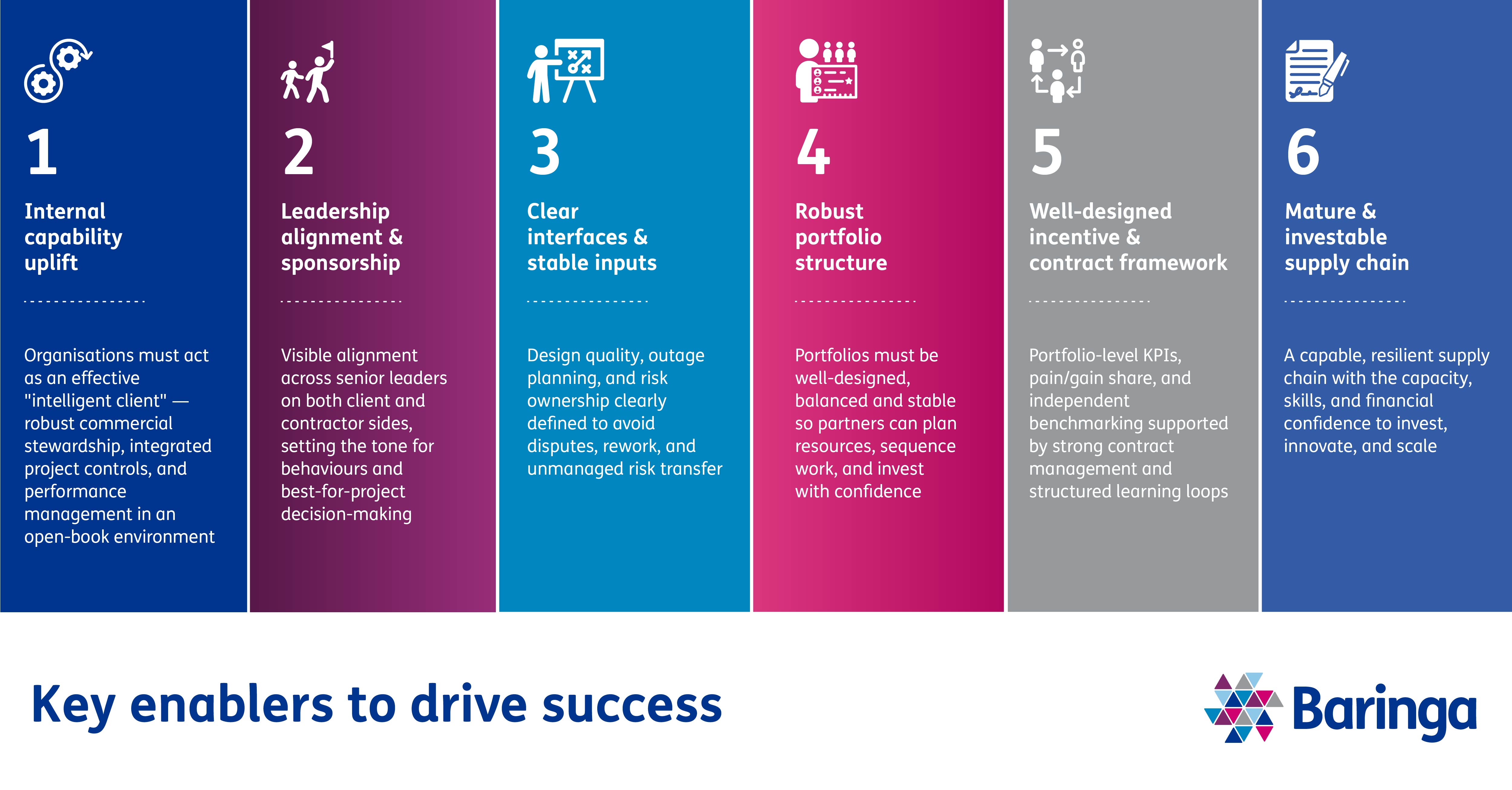
Leadership alignment and sponsorship
Misaligned leadership quickly undermines collaboration. Senior sponsors on both the owner and supplier side must reinforce shared objectives when pressure emerges. Without this, behaviours revert and decisions stall.
Intelligent client capability
Collaboration increases the need for strong owner capability. Asset owners must retain robust commercial stewardship, integrated project controls and effective assurance. This underpins value‑for‑money arguments and limits retrospective challenge.
Stable and credible portfolio structure
Collaborative models deliver most value across portfolios, not isolated projects. A visible and balanced pipeline allows suppliers to plan, invest and improve productivity. Portfolio volatility increases cost and weakens accountability.
Well‑designed incentives and governance
Pain/gain mechanisms and portfolio‑level KPIs must be tightly defined and actively governed. Weak incentives drive cost drift; weak governance erodes control. Both create exposure at board level – for clients and suppliers!
Clear interfaces and disciplined inputs
As contractual demarcation softens, clarity becomes more important. Design quality, interface ownership, outage planning and access arrangements must be explicit. Integration does not remove the need for discipline.
Mature and investable supply chain
Collaboration relies on suppliers that are financially robust and willing to invest for the long term. Where the supply chain is fragmented or distressed, owner exposure increases.
Sector‑specific considerations
While the principles of collaboration are consistent, the drivers differ by sector.
For regulated networks and water companies, collaboration is often driven by increases in portfolio scale and complexity, the need to secure capacity, increased risk transfer from regulatory to utility companies, the drive for innovation and the need to demonstrate efficiency, comparability and assurance to regulators.
For oil and gas operators, collaboration is more often about managing brownfield risk, safety‑critical interfaces, reducing outage duration and driving capital efficiency under volatile price conditions.
In both cases, the contracting model must support defensible decisions when outcomes are challenged.
Sector‑wide outcomes that shape board judgement
Across regulated energy and water networks and oil and gas similar outcomes emerge where collaborative approaches are aligned to risk and capability. Typically we see:
- Fewer late‑stage scope changes through earlier constructability input
- Improved predictability in brownfield and high‑interface environments
- Stronger assurance narratives supported by transparent cost and risk data
- Improved innovation supporting schedule and cost improvements
- Capability retained across portfolios rather than reset on each project
- Enhanced capacity, trust and long term focus
Where these outcomes are absent, the consequences are clear. Loss of cost visibility and weakened assurance lead to increased intervention and reduced confidence in downstream schemes.
We have supported utility companies and international oil companies across multiple markets to realise these benefits. The context is rarely static or simple, and the challenges are seldom straightforward, but the outcomes are tangible and material.
Asset‑owner decisions that matter
For boards and senior sponsors, collaborative contracting is a sequence of deliberate choices.
These include:
- Where collaboration adds value within the portfolio, and where traditional EPC remains appropriate
- How far along the spectrum to move, balancing risk reduction against mobilisation time and governance effort
- What capability must be established first, particularly in project controls, commercial management and assurance
- How the model will stand up to challenge from regulators, auditors and internal assurance
Most organisations benefit from a staged approach. Piloting collaborative models on selected assets allows capability to mature and risks to be understood before scaling.
Closing perspective
Collaborative contracting is about making explicit choices that support safe delivery and credible cost recovery.
For asset owners facing complex capital programmes, the right collaborative approach can materially reduce delivery risk. The wrong one increases exposure. The difference lies in alignment, capability and discipline.
Speak to our capital delivery specialists to assess whether collaborative contracting is right for your portfolio.
Talk to our experts:
Chris Heron, Expert in Capital Delivery and Supply Chain
Joao Fonte, Expert in Programme Delivery and Digital Transformation
Related Insights

Organisational agility: a guide to taking the first steps
Our business agility and operational excellence expert Simon Tarbett offers some advice to clients when asked the question, Where To Start?
Read more
The need for agility to grow revenue and thrive in a turbulent market
We’re looking at how organisations need to be agile if they’re to grow revenue and thrive in a turbulent market.
Read more
How to set targets to drive business performance
Targets are essential for driving better business results. Let’s discuss what companies should – and shouldn’t – be doing.
Read more
How frozen organisations can become fluid
To develop organisational agility, focus on being like water.
Read moreIs digital and AI delivering what your business needs?
Digital and AI can solve your toughest challenges and elevate your business performance. But success isn’t always straightforward. Where can you unlock opportunity? And what does it take to set the foundation for lasting success?