
From energy shock to asset shock. Are we in an AI bubble?
Part of Baringa's Horizons Series
Key takeaway: The big question for markets is no longer just whether the global economy can take an energy shock. It is whether AI and technology companies can deliver the growth baked into their share prices. Energy markets have proven more resilient than expected. Whether technology firms can achieve the growth implied by current valuations remains uncertain.
Why do high AI valuations create economic risks?
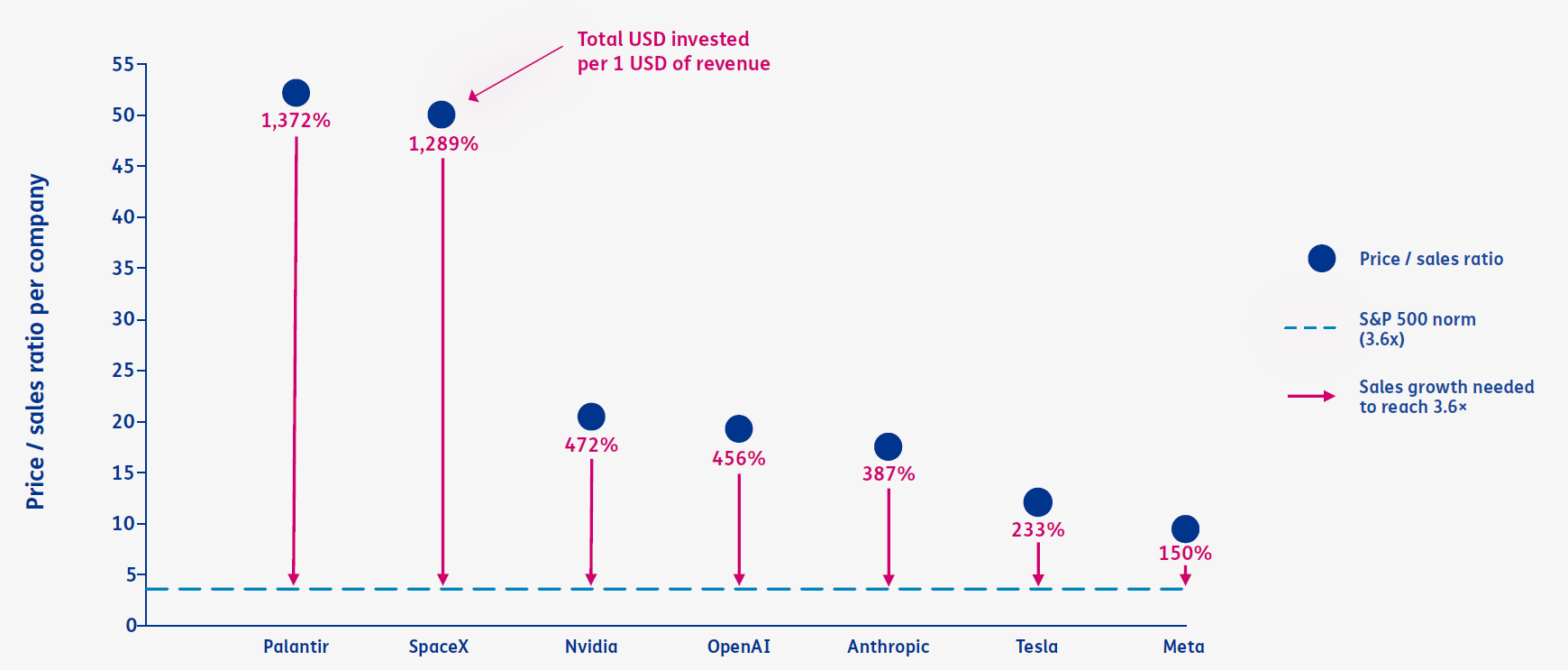
Frontier compute performance has grown about 2.5x each year since 2019; however, the money flowing into tech stocks may have moved ahead of actual company revenues. The Magnificent 7 now account for more than a third of the S&P 500, more than double the concentration seen at the peak of the Dot-com boom. Everyday investors keep putting money in, while professional fund managers are pulling cash out.
Three things could burst this bubble without the technology itself failing:
- Slow payoff: Almost 9 in 10 big firms use AI, yet over half of chief executives report no clear boost to revenue or bottom-line savings so far.
- Cheaper Chinese rivals: Chinese models now occupy a similar performance band to their US counterparts, but at a materially lower cost per task. US AI labs are valued at USD 7.4tn, compared to USD 455bn for their Chinese counterparts.
- Higher interest rates: Most of what investors pay for today rests on profits promised 10 to 20 years down the line. Higher interest rates quickly make those distant earnings worth less today.
What investors pay today vs the sales growth needed to justify it
Why could an AI slump hit the real economy harder than the Dot-com crash?
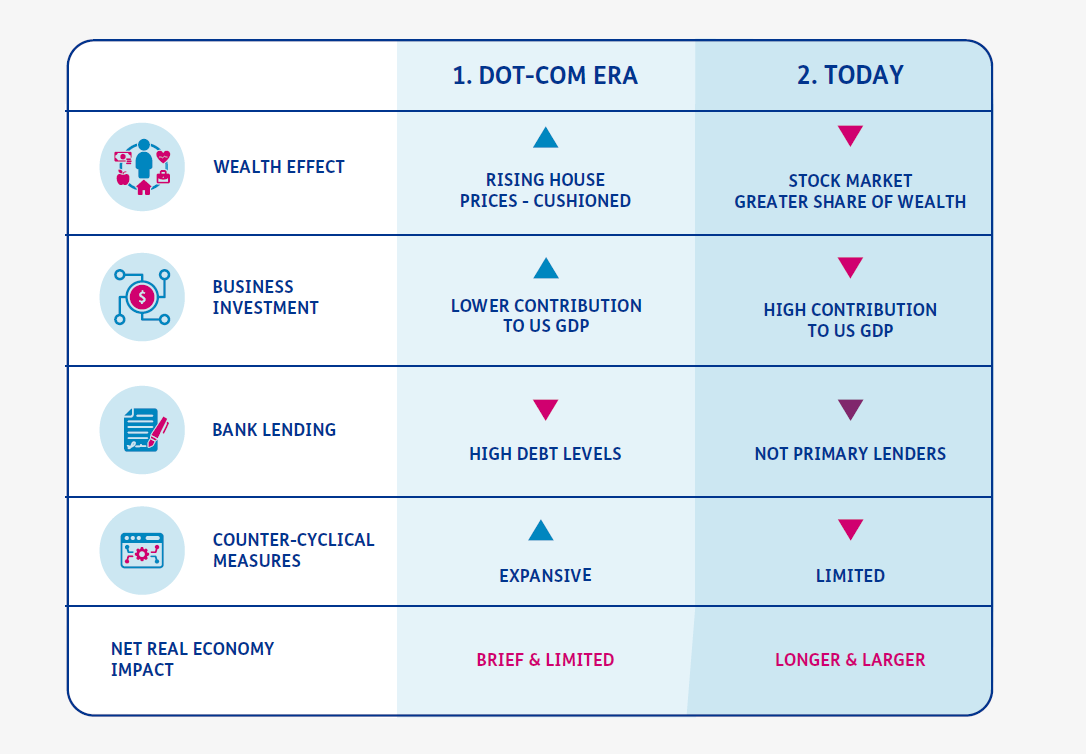
A stock market drop hurts the broader economy in three ways: household wealth shrinks, business investment stops, and loans dry up. During the Dot-com crash, rising house prices protected household savings. Today, households have more money tied up in stocks and less in housing.
Business investment matters much more to GDP today. Software and computers make up nearly 40% of US private investment, up from under 20% a decade ago. In fact, AI spending has driven about three-quarters of recent US economic growth. If tech spending drops, central banks and governments have less room to cut rates or spend money to rescue growth.
Our modelling suggests an AI-driven market correction in 2027 could reduce US growth to around 0.3%, with a more severe scenario resulting in a significant contraction of around 1.0%.
Drivers appear to point to a larger shock than the Dot-com era
Has the energy shock been delayed or averted?
Crude oil and gas prices have stayed well below our Q2 crisis forecast. Global energy markets adapted faster than feared thanks to three main shock absorbers:
- US LNG exports: Strong growth in North American gas shipments helped offset lost Qatari volumes through the Strait of Hormuz.
- Partial shipping recovery: Oil shipments through the Strait of Hormuz rebounded from early crisis lows of 2 to 5 mb/d to over 10 mb/d during the Memorandum of Understanding (MoU) window.
- Milder growth downgrades: Services activity picked back up across major economies, leaving full-year GDP forecasts far more resilient than initial panic models assumed.
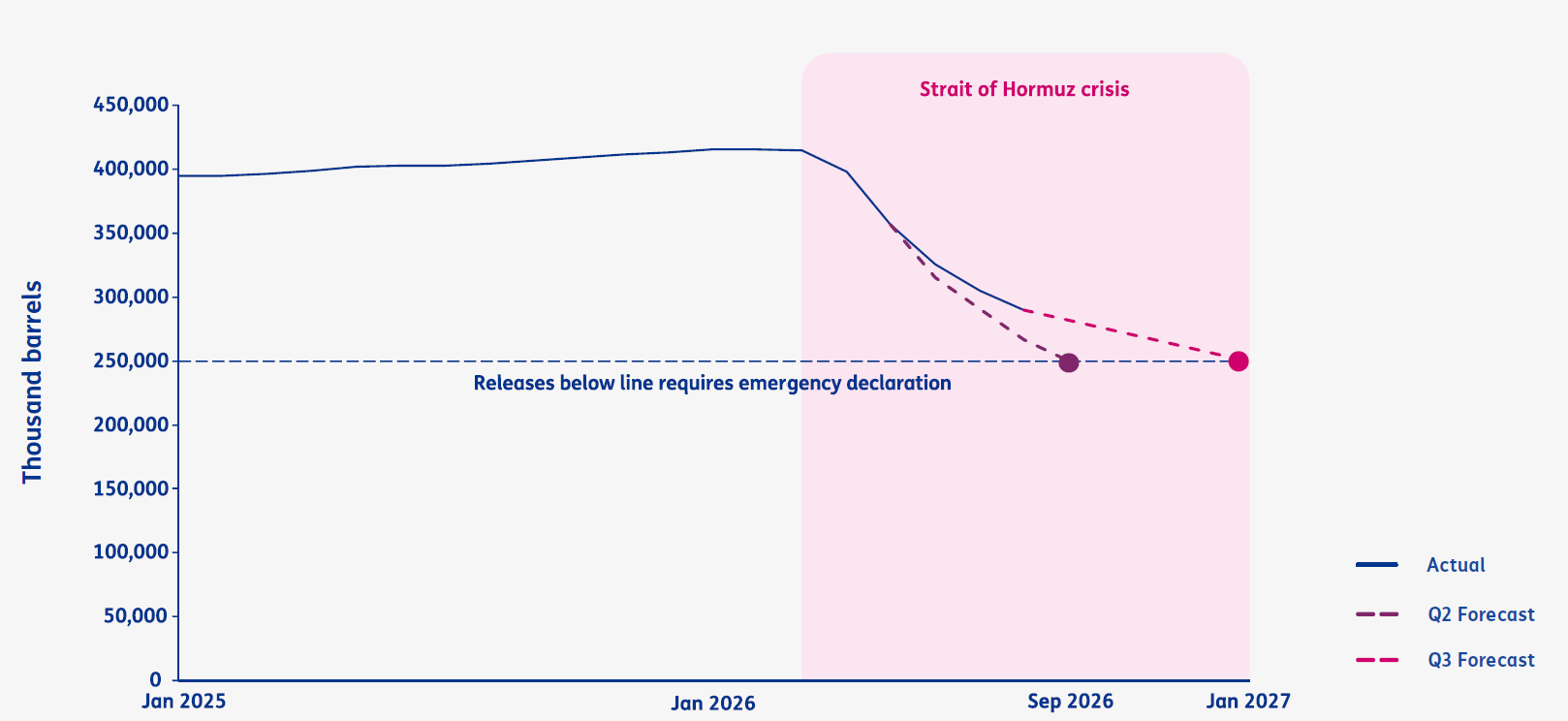
However, the underlying risk has not disappeared. US crude oil stockpiles continue to drain steadily. On current trends, inventories are on track to fall below the line requiring a formal emergency declaration in January 2027. Short-term relief from reserve releases, fuel switching and spare OPEC capacity is temporary by nature.
Total visible US oil inventories, in thousands of barrels
This leaves central banks with less room to ease policy. Rather than cutting rates aggressively, markets now price a delayed and shallower easing cycle across the US, UK and Eurozone. Energy-importing economies across the UK and Europe remain especially sensitive to any renewed spike in commodity prices.
Frequently asked questions
Are we in an AI bubble?
The market displays several characteristics commonly associated with asset bubbles, including rapid technological progress, elevated valuations, strong retail participation and extreme market concentration. Whether this ultimately proves to be a bubble will depend on whether future revenues match current expectations.
What could cause an AI market drop?
Three main things: businesses taking longer than expected to turn AI into actual profits, cheaper Chinese models undercutting US prices, or higher interest rates making distant future earnings less valuable today.
Why would an AI slump hurt more than the Dot-com crash?
Families have more of their wealth in shares than they did in 2000, tech investment drives a much bigger share of economic growth, and governments have less cash and higher inflation, giving them less room to step in.
What could happen to US growth?
If spending on AI simply levels off, US growth drops from 1.5% to 0.3%. If tech shares and investment fall sharply in 2027, the US economy could enter a mild recession of around 1.0%.
Is the Middle East energy crisis finished?
No. Prices have come down from earlier highs, but US oil reserves continue to fall toward emergency levels by January 2027. The disruption has been delayed rather than solved.
Our Experts


Related Insights

Unlocking value with economics and industry insight
Unlock economic value with sharper policy and regulation. Our expert analysis empowers regulators and businesses to make confident, value-driven decisions.
Read more
Horizons Series: Insights for Navigating What's Next
Explore Baringa's Horizons Series for expert analysis on economic shifts, consumer trends, energy markets, and strategic planning
Read more
UK consumer spending outlook H2 2026
UK consumer spending is proving more resilient than expected, but growth is increasingly concentrated among affluent households. Discover who is spending and who is not.
Read more
Global macroeconomic outlook Q2 2026
Understand the key economic forces shaping 2026, from inflation and interest rates to geopolitical risk, growth prospects and sector impacts.
Read moreIs digital and AI delivering what your business needs?
Digital and AI can solve your toughest challenges and elevate your business performance. But success isn’t always straightforward. Where can you unlock opportunity? And what does it take to set the foundation for lasting success?
 Keep up to date
 Our industry insights